
Packaging Guides
Why Two Identical-Looking Tape Rolls Can Cost Differently
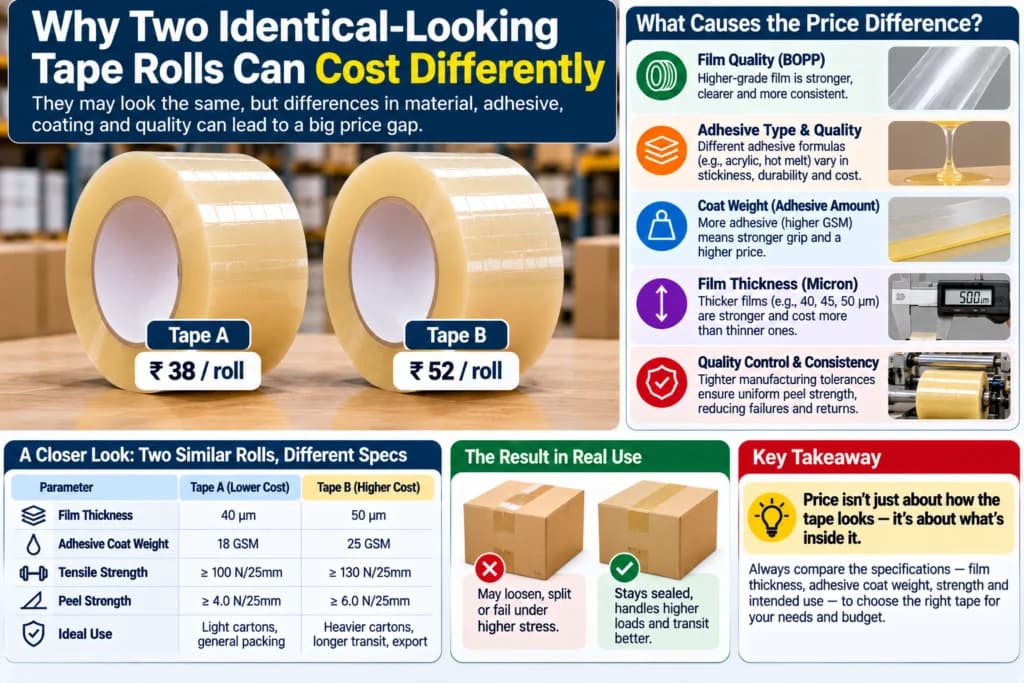
A buyer once asked us why one supplier’s 48mm tape was cheaper than ours when both rolls looked exactly the same size. Same core, same width, same colour of packaging. The answer was in the micron and the length wound on the roll, neither of which you can see by eyeballing a carton of tape sitting on a shelf.
Tape pricing is not really about the roll. It is about how much BOPP film and adhesive went into making it. Three numbers decide that: width, length, and micron thickness. Get these three and you can roughly work out why one roll costs more than another, even when they look identical.
Film usage is the real cost driver
BOPP tape is film coated with adhesive. The raw material cost is driven by the volume of film used per roll, not by the roll’s outer appearance. Volume here means three dimensions multiplied together: width in mm, length in metres, and micron thickness.
A 48mm x 65m roll at 40 micron uses noticeably less film than a 48mm x 65m roll at 60 micron, even though both rolls carry the same label dimensions and may look similar on a pallet. The thicker one is heavier, it holds more raw material, and it costs more to produce. That difference shows up directly in the per-roll price.
Width
Width is the easiest variable to check and the one buyers compare first. We manufacture jumbo rolls from 192mm up to 1320mm and slit them down to standard widths like 24mm, 36mm, 48mm, and 72mm for retail use. Wider tape uses proportionally more film, so cost scales almost linearly with width if length and micron stay constant.
Length
Length per roll varies more than people expect. Two rolls both labelled “48mm tape” might be wound to 65m, 100m, or 130m. A longer roll naturally costs more in absolute terms, but the real question for a buyer is cost per metre, not cost per roll. A roll that looks cheaper per piece can actually work out more expensive per metre if it is wound shorter.
Micron
Micron is thickness, and it is the variable most often hidden in a quote. We typically supply:
- 35-40 micron: light cartons, short transit, low handling
- 45 micron: standard e-commerce and FMCG cartons
- 50-60 micron: heavier cartons, longer transit routes
- 65 micron and above: export shipments, repeated handling, long storage
Each step up in micron adds material cost. A 45 micron roll and a 60 micron roll in the same width and length are not the same product even if the box they ship in looks identical. The thicker tape should cost more, and if it doesn’t, something else has been cut, usually adhesive coat weight or film quality.
Why two rolls can look the same and cost differently
This is where buyers get caught out. A roll’s outer diameter depends on width, length, and micron together, not on any single one of them. So a supplier can quietly reduce length while keeping width and micron the same, and the roll will look only slightly smaller, easy to miss on a quick visual check. Or they can drop micron while keeping length the same, and the roll looks identical in diameter but seals weaker and runs out of adhesive strength faster on heavier cartons.
Neither change is visible unless you check the label specs and, ideally, weigh the roll. Two rolls of near-identical appearance can differ by 15-20% in actual film content, and that difference is exactly where price gaps come from.
What to actually check on a quote
When comparing tape prices from different suppliers, ask for all three numbers together, not just one:
- Width in mm
- Length in metres per roll
- Micron thickness of the film
Once you have all three, divide price by width x length x micron, or more simply, calculate cost per square metre of film. That number tells you whether you are comparing like with like. A per-roll price alone tells you almost nothing.
It also helps to ask what the tape is meant for. A 45 micron roll suited to light e-commerce cartons will always be priced below a 60 micron roll meant for heavier cartons or longer transit, and that is correct, not a red flag. The red flag is when two rolls claim the same specs but carry very different prices, because somewhere in the film, adhesive, or length, corners have likely been cut.
Matching spec to actual use
The cheapest roll on a quote sheet is not always the cheapest tape for the job. If a 40 micron roll fails in transit and the carton reopens, the cost of a reship or a damaged product return is far higher than the few rupees saved per roll. Matching micron to actual carton weight, number of handling points, and transit length is the more useful way to think about tape cost, rather than comparing roll prices in isolation.
We manufacture across the full width range from 192mm to 1320mm jumbo and mini jumbo rolls, and across the 35 to 65+ micron range, under one roof at our Mundka facility. If you are comparing quotes and the numbers don’t add up, send us the specs and we can tell you where the gap likely is.
Your product, our package
Send us your requirement
Widths, colours, artwork, monthly volume: share what you need and we will come back with a price and a date.