
Packaging Guides
Why Regular Carton Tape Fails in Cold Storage and Pharma Chillers
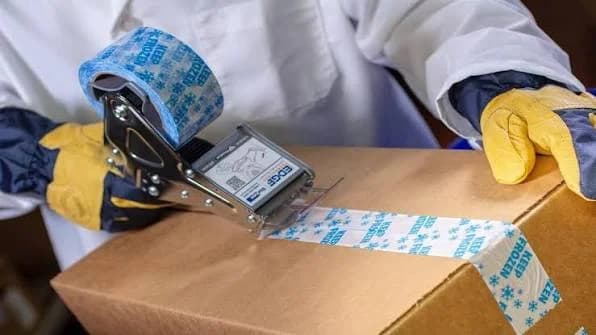
If you run a cold store or pack pharma cartons for cold-chain dispatch, you’ve probably seen this: cartons sealed fine on the packing line, sat in the chiller overnight, and by morning the tape flap has lifted at the corners. Nothing broke the seal physically. The tape just let go on its own.
This is not a one-off defect. It is a predictable reaction between adhesive chemistry and temperature, and it happens more often than most warehouse managers realise because the tape was never chosen with the chiller in mind.
What actually happens to adhesive in the cold
Acrylic adhesive works by staying slightly soft and tacky at room temperature, so it flows into the surface of the carton and grips. That softness comes from the polymer’s own mobility, and mobility drops sharply as temperature falls. Below roughly 5 to 10°C, standard acrylic adhesive starts to stiffen. It stops flowing into the fibres of the corrugated box and just sits on top of it.
A stiff adhesive has less contact area with the surface. Less contact area means lower bond strength. The tape is still stuck, technically, but the peel strength has dropped enough that a bit of handling, stacking pressure, or a knock during loading is enough to lift an edge.
This is why the failure shows up after storage, not immediately after sealing. The bond looks fine on the line at ambient temperature. It only weakens once the carton spends hours inside the cold room.
Condensation makes it worse
Temperature swings in cold storage almost always bring moisture with them. When a carton moves from a chiller into a loading bay, or from cold storage into an ambient truck, the surface of the box can pick up condensation as it warms. The same happens in reverse when warm cartons enter a cold room and moisture forms on the surface before the box cools down.
Water on the carton surface at the moment of sealing, or forming underneath the tape later, is one of the fastest ways to break an adhesive bond. Acrylic adhesive bonds by displacing air and gripping fibre, and a film of moisture between the tape and the board gives it nothing to grip. Combine that with an adhesive that’s already stiffened by cold, and you get seals that fail at the exact point where a shipment can least afford it, in transit, unsupervised.
Why standard 45 micron tape isn’t built for this
Most general purpose BOPP tape, including the 45 micron grade widely used for e-commerce and FMCG cartons, is formulated to perform well at normal ambient handling temperatures. It’s a good, cost-effective choice for a courier network or a dry warehouse. It was never designed to hold adhesion at single-digit or sub-zero temperatures for extended periods.
Using that same tape on cold-chain cartons is where most of the field failures come from. It’s not a defective batch of tape, it’s the wrong grade of adhesive for the application.
What to look for instead
For cold storage, pharma cold-chain, and frozen or chilled FMCG dispatch, the adhesive formulation needs to stay tacky at lower temperatures, not just the film thickness. A few practical points:
- Ask for a low-temperature adhesive grade specifically, not just a thicker tape. Micron thickness affects tear resistance and load-bearing, it does not fix a cold adhesion problem on its own.
- Check the minimum application temperature the adhesive is rated for, and compare it against your actual chiller or cold room temperature, not just the ambient dispatch temperature.
- Seal cartons before they go cold whenever possible. Applying tape at room temperature and then moving the sealed carton into cold storage generally holds better than trying to seal a carton that has already been sitting in the chiller.
- Watch for surface moisture before sealing. If cartons have come out of a cold room and picked up condensation, wipe the sealing flap dry before taping. A damp surface will undermine even a good low-temperature adhesive.
- Test at your actual conditions, not room temperature. A tape that seals perfectly on a warm packing line can still fail once it’s been sitting at 2°C for six hours. If you can, run a trial batch through your real storage cycle before committing to a full order.
Where 50-60 micron and higher grades fit in
Heavier micron tape, in the 50 to 60 range or 65 and above, is often paired with cold-chain use because these cartons tend to travel further, get handled more times, and sometimes get restacked at multiple cold points between manufacturer and pharmacy or retailer. The extra film thickness helps with tear resistance and repeated handling, but it’s the adhesive formulation underneath that determines whether the seal survives the temperature swing. Thickness and cold-adhesion are two separate specifications, and both matter for this application.
The practical takeaway
If your cartons are moving in and out of chillers, cold rooms, or refrigerated trucks, don’t default to whatever tape is already on the packing line. Ask your supplier directly whether the adhesive is rated for low-temperature application and holding, and get that in writing on the datasheet rather than assuming standard acrylic will manage. A seal that lifts in transit isn’t just a packaging cost, for pharma and cold-chain goods it’s a compliance and product-integrity problem.
At Sonison, we manufacture BOPP tape with water-based acrylic adhesive across multiple micron ranges, and we work with buyers to match the adhesive grade to the actual storage and transit conditions rather than a generic spec sheet. If cold storage or pharma cold-chain is part of your dispatch, it’s worth a conversation before the next order goes out.
Your product, our package
Send us your requirement
Widths, colours, artwork, monthly volume: share what you need and we will come back with a price and a date.