
Packaging Guides
What Actually Happens When You Order Printed BOPP Tape
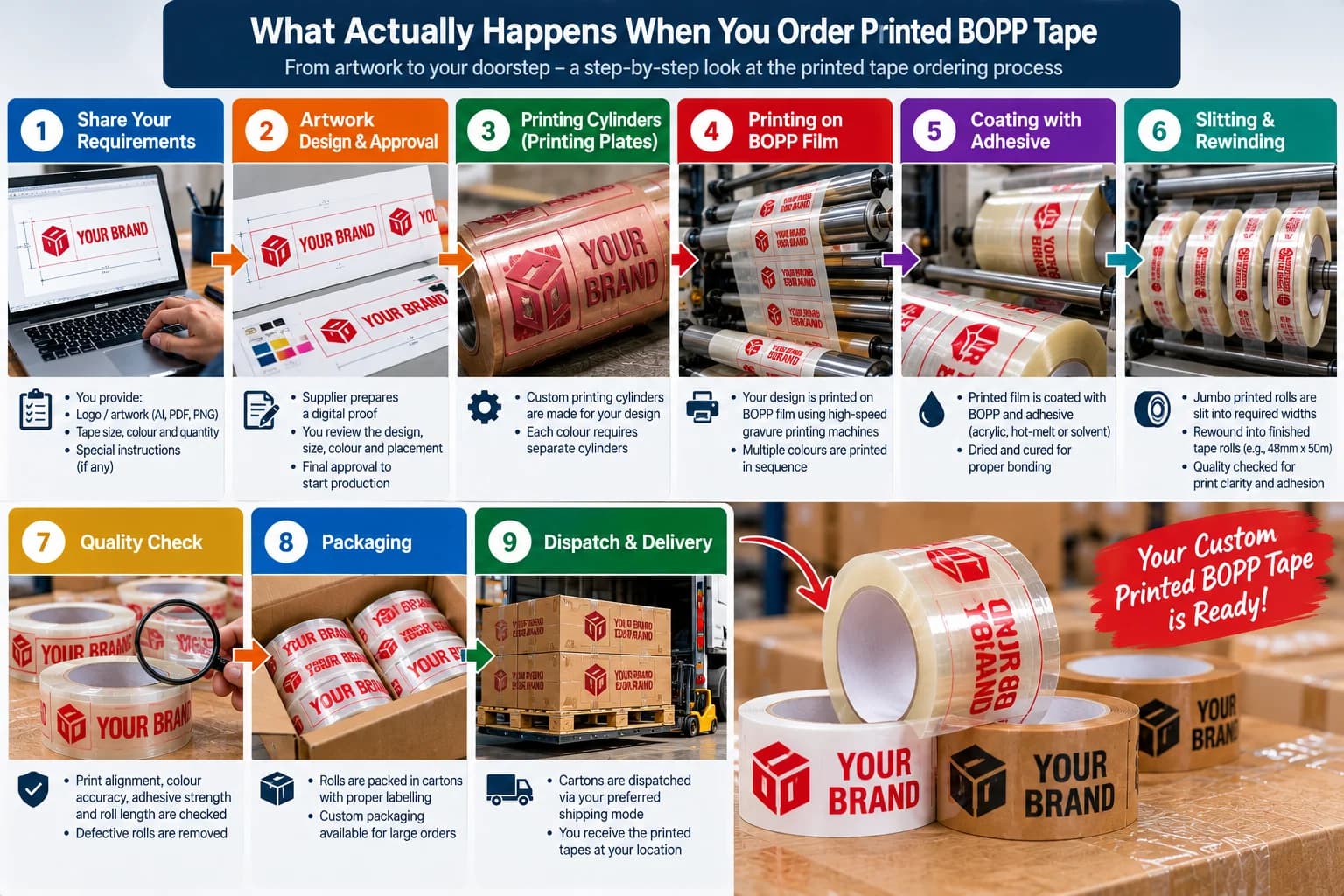
Most buyers ordering printed tape for the first time assume it works like a regular print job: send a logo, pick a colour, get a quote. Rotogravure printing on BOPP film runs on a different logic. The cylinder, the colours, and the minimum quantity are all connected, and if you don’t understand that connection you end up with delays or a design that has to be redone mid-order.
Here is what actually happens between the day you send artwork and the day printed rolls leave the Mundka facility.
Artwork requirements
Rotogravure printing needs vector artwork, not a JPEG pulled off a website. The usual acceptable formats are AI, EPS, or a high resolution PDF with outlined fonts. If your design team only has a PNG logo, it has to be redrawn in vector first, which adds time before production even starts.
A few practical points that matter for tape specifically:
- Text below a certain point size gets blurry at high press speeds. Fine print and thin serif fonts don’t reproduce well on a 2 or 3 inch tape width.
- Repeat length matters. The design repeats continuously along the roll, so the artwork has to be set up to tile cleanly without an odd gap or overlap where one repeat ends and the next begins.
- Colour should be specified in Pantone references, not just “our brand blue.” RGB and screen colours don’t translate directly to ink on film.
- Keep the design simple if you want consistent print quality run after run. Dense background colour across the full width shows any variation in adhesive coating or film tension more than a simple logo with white space around it does.
Colour separation
Sonison prints up to 3 colours on custom tape. Each colour in your design needs its own separation, and each separation needs its own cylinder. A two colour logo is not twice the work of a one colour logo, it is a different cylinder cost and a different press setup, because the film has to pass through registration for each colour in sequence.
If your logo has a gradient or a photographic element, it has to be converted to flat spot colours before separation. Gradients don’t reproduce reliably in gravure printing on tape. We’ll usually flag this at the artwork stage and suggest a flat colour alternative that still looks close to the original design.
Cylinder cost
The printing cylinder is engraved specifically for your artwork, in your repeat length, in your tape width. This is a one-time cost charged separately from the tape itself. It is not a running cost per roll, it is a fixed cost for the engraving, and it is why printed tape has a minimum order quantity that plain tape doesn’t.
Once the cylinder is made, it belongs to that order and can be reused for repeat orders of the same design and width. This is why repeat customers get faster turnaround and lower effective cost per order on the second and third run, the cylinder expense was already covered the first time. If you change the width, the design, or the colours, a new cylinder is needed.
Minimum order quantity
Because of the cylinder cost, custom printed tape has a higher MOQ than plain or coloured tape. The exact number depends on width and number of colours, but it is set so the cylinder cost doesn’t make the per-roll price unreasonable. If your actual requirement is small, ask about combining a few widths on fewer colours, or check whether your order qualifies for a smaller trial run before committing to a full production batch.
Buyers sometimes ask if they can print a small test batch to check how the logo looks on the roll before placing a full order. This is worth asking about directly, since gravure cylinder cost makes very small trial runs impractical in most cases, but a reasonable middle ground can usually be worked out.
Lead time
A printed tape order takes longer than a plain tape order, and the extra time comes from three places: artwork finalisation, cylinder engraving, and production scheduling on the printing line. Artwork approval is the step most within your control. Delays in sign-off on proofs push the whole order back, since the cylinder can’t be engraved until the design is locked.
Once artwork is approved, cylinder engraving takes a fixed number of days, followed by the actual coating, printing, and slitting of the jumbo roll into finished sizes. If you know you’ll need printed tape for a seasonal push, say a festival sale or an export shipment cycle, it pays to start the artwork conversation weeks ahead rather than the week you need stock.
What to send when you request a quote
- Vector artwork file with Pantone colour references
- Tape width and roll length required
- Micron thickness, based on carton weight and transit length
- Expected order quantity, even if approximate, so cylinder cost can be worked into the quote properly
- Delivery timeline, so we can flag upfront if the cylinder and production schedule will meet it
Printed tape is a good branding tool for e-commerce and FMCG dispatch once it’s set up properly, but it’s not a same-week order like plain tape. Understanding the cylinder and colour separation steps upfront helps you plan the order with enough lead time, instead of finding out about the schedule after you’ve already committed to a ship date.
Your product, our package
Send us your requirement
Widths, colours, artwork, monthly volume: share what you need and we will come back with a price and a date.