
Packaging Guides
Tensile Strength in BOPP Tape: What N/25mm Actually Means
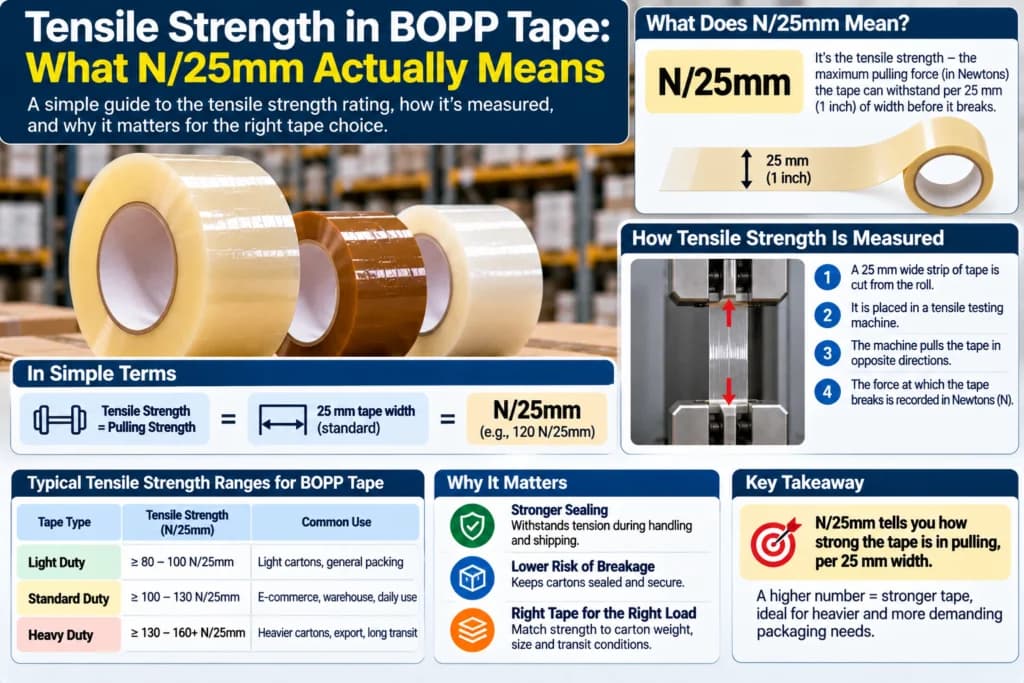
Every tape spec sheet has a tensile strength number written as something like “38 N/25mm” or “45 N/25mm”. Most buyers skip past it and look at micron thickness instead. That is a mistake. Tensile strength tells you whether the tape will hold together under load, not just whether it looks thick enough.
This article explains what the number means, how it is actually tested, and what range is good enough for common packing jobs.
What tensile strength actually measures
Tensile strength is the maximum pull force a strip of tape can take before it breaks. It has nothing to do with adhesion or stickiness. You can have a tape with excellent peel strength (it sticks hard to the carton) but weak tensile strength (the film itself snaps if someone yanks it or a box gets dragged across a conveyor edge).
Think of it as the backbone strength of the BOPP film, separate from the glue layer on top.
Why it is written as N/25mm
N stands for newtons, a unit of force. The 25mm refers to the width of the tape sample used in the test, not your actual roll width. Testing labs cut a standard 25mm wide strip from the tape, regardless of whether the roll itself is 48mm, 72mm, or something custom.
So “40 N/25mm” means: a 25mm wide strip of this tape can take 40 newtons of pulling force before it tears. If your tape is wider, say 48mm, you get roughly proportional strength across the full width, but the spec is always normalised to 25mm so different tapes can be compared on equal footing.
How the test is actually done
The standard method most manufacturers reference is ASTM D3759 or an equivalent. In practice it works like this:
- A 25mm wide, fixed-length strip of tape is cut from the roll.
- Both ends are clamped into a tensile testing machine.
- The machine pulls the two clamps apart at a steady, controlled speed.
- The force is recorded continuously until the tape snaps.
- The peak force recorded before breakage is the tensile strength value.
The same test also gives you elongation at break, usually shown as a percentage. That number tells you how much the tape stretches before it tears. A BOPP tape typically stretches somewhere between 100% and 150% of its original length before breaking. This stretch matters in real use too, a tape with some give absorbs shocks during handling better than one that is stiff and brittle.
Typical tensile strength ranges by micron
Tensile strength generally rises with film thickness, though adhesive formulation and film quality also play a part. As a rough guide, based on standard BOPP film used in self-adhesive tape:
- 35-40 micron tape: tensile strength usually in the 28-35 N/25mm range. Fine for light cartons and short transit.
- 45 micron tape: typically 32-40 N/25mm. This is the standard most e-commerce and FMCG shipments use.
- 50-60 micron tape: usually 38-48 N/25mm. Suited to heavier cartons and longer transit routes.
- 65 micron and above: often 45 N/25mm and higher. Used for export cartons that get handled repeatedly and stored for long periods.
These are general ranges, not fixed guarantees. Two tapes of the same micron can show different tensile numbers depending on the film grade and coating process. That is why asking for the actual test report matters more than assuming thickness alone tells the full story.
What counts as “good enough”
There is no single correct tensile strength. It depends entirely on what the carton goes through.
For a light e-commerce parcel moving through a few courier hubs over two or three days, a tape in the 32-38 N/25mm range is usually enough. The carton itself is light, handling is relatively quick, and the tape just needs to hold the flaps shut and resist a bit of friction.
For FMCG cartons going through automated packing lines with repeated conveyor transfers, something in the 38-42 N/25mm range holds up better, especially where cartons get pushed, stacked, and re-handled at distribution points.
For export shipments going by sea freight, cartons sit in containers for weeks, get loaded and unloaded multiple times, and face temperature swings. Here, 45 N/25mm and above is the safer choice, paired with adequate micron thickness so the tape does not just stretch and fail slowly under sustained pressure.
For furniture, heavy goods, or anything with sharp edges and repeated handling, higher tensile strength paired with higher elongation at break matters. A tape that can absorb some stretch before failing survives rough handling better than a stiffer, higher-strength tape that snaps the moment it hits its limit.
Reading a spec sheet without getting fooled
When you get a tape sample or spec sheet, check these together, not in isolation:
- Tensile strength in N/25mm
- Elongation at break percentage
- Micron thickness
- Peel strength or adhesion value
A high tensile number paired with very low elongation can mean a tape that is strong but brittle, it holds under steady pull but can crack under sudden shock. A balanced spec, where tensile strength and elongation are both reasonable for the micron grade, usually performs better in actual transit conditions than one number alone would suggest.
At Sonison, every batch of BOPP tape coming off our line in Mundka goes through tensile and peel testing before it is slit and packed. If you are specifying tape for a particular route or load, it is worth asking your supplier for the actual test data rather than relying on the micron number printed on the box.
Your product, our package
Send us your requirement
Widths, colours, artwork, monthly volume: share what you need and we will come back with a price and a date.