
Packaging Guides
Sealing Tape for Publishers: Bundling, Moisture and Volume Costs
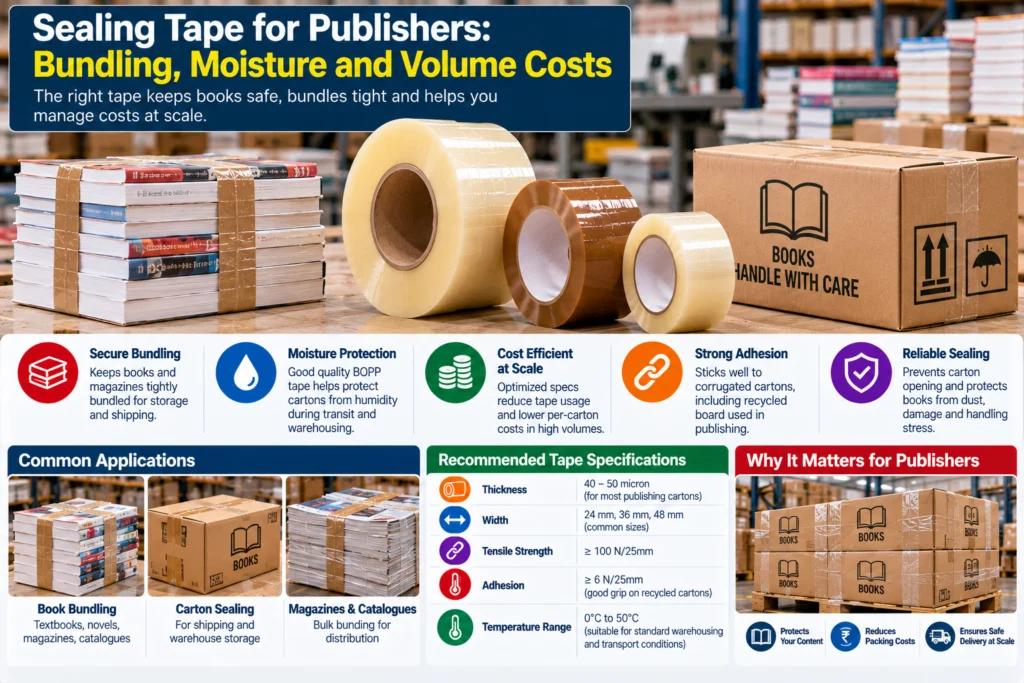
Publishers and printers are not a typical carton-sealing customer. Most of the material moving through a publishing house or print shop is paper itself, books, magazines, catalogues, textbooks, ream stock, printed sheets waiting for binding. That changes what the tape actually needs to do. It is not just closing a box. It is holding bundles together, keeping moisture off paper that swells and warps if it gets damp, and doing all of this at a volume where even a small price difference per roll adds up fast.
Bundling is a different job than carton sealing
A lot of print and publishing dispatch involves strapping or taping stacks of books, brochures, or paper reams directly, sometimes with corner boards or wrap, sometimes without. This puts tape under a different kind of stress than a sealed carton flap. The tape has to grip a flat, often slightly uneven paper surface, resist the bundle shifting during loading, and not peel at the edges where handlers grab the stack.
For this kind of use, adhesion quality matters more than headline thickness. A 45 micron tape with good water-based acrylic adhesive will hold a paper bundle better than a thicker tape with weak tack, because the bond depends on contact with the paper surface, not on film strength alone. If your bundles are heavier, 50 to 60 micron gives more tear resistance when someone drags a stack across a table or a trolley edge catches the tape line.
Moisture is the real enemy, not rough handling
Publishers worry less about drop damage and more about what humidity does to paper stock sitting in a warehouse or moving through a non-climate-controlled transport leg. Paper absorbs moisture, pages cockle, covers warp, and a damp carton of books is often unsellable even if nothing physically broke. Tape does not waterproof a carton on its own, but a weak seal is where moisture gets in first, at the flaps and the bundle edges.
This is where tape quality on the seam itself matters. A consistent, full-width adhesive coat without gaps or thin patches closes that entry point. Cheap tape with uneven coating looks fine on the roll but leaves micro-gaps along the seal that let humidity creep in over weeks of storage, which is exactly the timeline for a lot of publishing inventory sitting in a godown between print runs and distribution.
For businesses storing finished stock for longer periods, 65+ micron tape is worth considering on the outer cartons, not because of physical toughness but because the thicker film and adhesive layer holds its seal better over extended storage than a thin, short-transit tape does.
Volume changes the economics
A print business sealing hundreds of cartons a week is in a different buying position than an e-commerce seller doing fifty parcels a day. At that volume, a few rupees difference per roll across thousands of rolls a year becomes a real budget line. But cutting micron thickness or adhesive quality to save on unit cost usually backfires through reseal labour, damaged stock, and returns from damp or reopened cartons. The cheaper roll ends up costing more once you count the rework.
The better lever for cost control at high volume is roll format, not tape quality. Jumbo rolls and mini jumbo rolls cut down on roll changes on the line, which matters when you are sealing hundreds of cartons a shift. Fewer roll changes means less downtime and less waste from partial rolls thrown away mid-run. We supply jumbo rolls in widths from 192mm to 1320mm, and print and publishing customers typically find a longer roll length in a standard width does more for their per-carton cost than switching to a thinner tape.
Plain tape usually wins over printed for this use
Unlike e-commerce or FMCG, most publishing and print dispatch does not need custom printed tape. The branding is already on the book cover or the carton label. Plain brown or natural tape at 45 or 50 micron covers the bundling and sealing job without the added cost and lead time of printed rolls. If there is a case for printed tape, it is usually for outbound shipments to distributors or retail chains where a visible brand mark on the tape line helps with recognition at the receiving dock, but this is the exception, not the default, for most print businesses.
A practical spec for publishing and print dispatch
- Bundling loose stacks (books, brochures, reams): 45 micron plain tape, good adhesion over tear strength.
- Standard carton sealing for distribution: 45 to 50 micron, standard width, jumbo rolls to cut roll-change downtime.
- Long-term warehouse storage of finished stock: 50 to 65 micron for a tighter, longer-lasting seal against humidity.
- Export or long-transit book shipments: 65+ micron, same logic as general export cartons, more handling and more time in transit.
We manufacture BOPP tape at our facility in Mundka, New Delhi, using water-based acrylic adhesive and in-house slitting, so we can supply jumbo and mini jumbo rolls in the widths and micron ranges publishing and print businesses actually use, without pushing printed tape where plain does the job just as well.
Your product, our package
Send us your requirement
Widths, colours, artwork, monthly volume: share what you need and we will come back with a price and a date.