
Packaging Guides
Sealing Tape for Cold Storage and Pharma: Why Chillers Break It
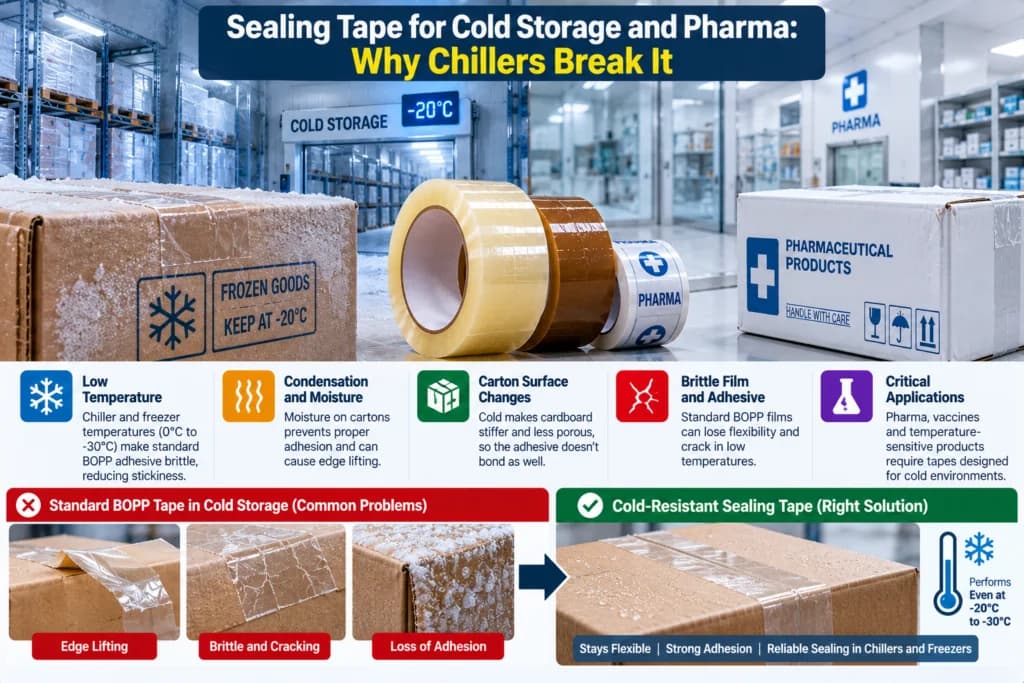
Warehouse managers running cold storage and pharma dispatch see a pattern that does not show up in a normal FMCG or e-commerce facility: tape that seals perfectly at the packing table lets go a few hours later. The carton looks fine when it leaves the line. By the time it has spent a night in a chiller or a reefer truck, the flap is loose or the tape has lifted at the corners. This is not a defective batch. It is a mismatch between the adhesive and the temperature it was asked to work in.
Why cold temperatures beat ordinary tape
Acrylic adhesive, the type used in most BOPP self-adhesive tape, works by staying soft enough to flow into the fibres of the carton surface and grip them. That softness comes from the adhesive’s internal mobility, which is directly tied to temperature. Standard acrylic formulations are built to perform well between roughly 15°C and 35°C, the range most warehouses and transit trucks actually sit in.
Below that range, the adhesive stiffens. It stops flowing into the corrugation and starts behaving more like a rigid film than a tacky coating. The tape still looks stuck when applied, because the applicator pressure forces initial contact, but the bond never develops proper tack. Within a few hours in a 2°C to 8°C pharma chiller, or a -18°C frozen storage room, that weak initial bond is all you have, and it is not enough to survive stacking, handling, or a forklift vibration.
Condensation makes it worse
Cold storage adds a second problem on top of low temperature: moisture. Every time a carton moves from a chiller into ambient air, or from a frozen room into a loading dock, condensation forms on the carton surface. Acrylic adhesive that is already stiff from cold temperature now has a thin film of water sitting between it and the carton. Standard formulations do not displace that moisture well. The result is a tape that peels back at the seam within minutes of the carton reaching ambient temperature, usually right at the point of handover or final delivery, which is the worst possible time for a seal to fail.
This cycle, cold to ambient and back to cold, repeats multiple times for a single pharma shipment moving through distribution. Each cycle is a fresh chance for the seal to give way if the adhesive was not built for it.
What a low-temperature grade actually changes
A cold-chain or low-temperature acrylic formulation is adjusted at the coating stage, not at the point of application. The adhesive chemistry is modified to stay tacky and flexible at lower temperatures, so it keeps flowing into the carton surface instead of going rigid. It also handles a damp or slightly condensed surface better, because the formulation is built to displace a thin moisture layer rather than being blocked by it.
Practically, this means:
- The tape holds initial tack even when applied in a chiller environment, not just when applied warm and then moved cold.
- Peel strength does not collapse after a cold to ambient cycle.
- The carton stays sealed through repeated temperature swings typical of pharma distribution, where a shipment might pass through a cold store, a transit vehicle, and a receiving dock in one day.
Where this actually matters
Not every cold-chain shipment needs a special grade. A carton packed at room temperature and shipped same day in a temperature-controlled vehicle may never see a real cold stress test. The grades matter most for:
- Pharma cold storage, where cartons sit in 2°C to 8°C rooms for days or weeks before dispatch, and the seal has to hold the whole time, not just during the initial pack.
- Frozen and deep-chill logistics, where temperatures go well below the working range of standard acrylic.
- Cross-dock cold chain, where cartons repeatedly move between chiller and ambient zones, each cycle adding condensation risk.
- Export pharma consignments, where the shipment may sit in a cold port warehouse for an extended period before loading, far longer than a typical domestic transit.
Micron thickness still matters, separately
Choosing a low-temperature adhesive grade does not replace the need to match tape thickness to carton weight. A 45 micron tape with the right adhesive will still underperform on a heavy, long-transit pharma carton if the gauge itself is too thin for the load. Cold storage tape decisions should look at both factors together: the adhesive grade for the temperature and moisture environment, and the micron thickness for the weight and handling the carton will go through. One does not fix the other.
What to ask your tape supplier
If cartons are moving through chillers, cold rooms, or frozen storage, it is worth asking directly whether the adhesive is a standard acrylic or a formulation adjusted for low temperature performance. Ask what temperature range it is rated to hold tack in, and whether it has been tested for performance after a cold to ambient cycle, not just at a single fixed temperature. A supplier running its own coating line should be able to answer this specifically rather than pointing to a generic datasheet line.
At Sonison Packaging, tape is coated and slit in-house in Mundka, Delhi, which means adhesive formulation questions like this one can be answered by the people actually running the coating line, not relayed through a trading desk.
Your product, our package
Send us your requirement
Widths, colours, artwork, monthly volume: share what you need and we will come back with a price and a date.