
Packaging Guides
Paper Cores and Tape Quality: Why Inner Diameter Matters
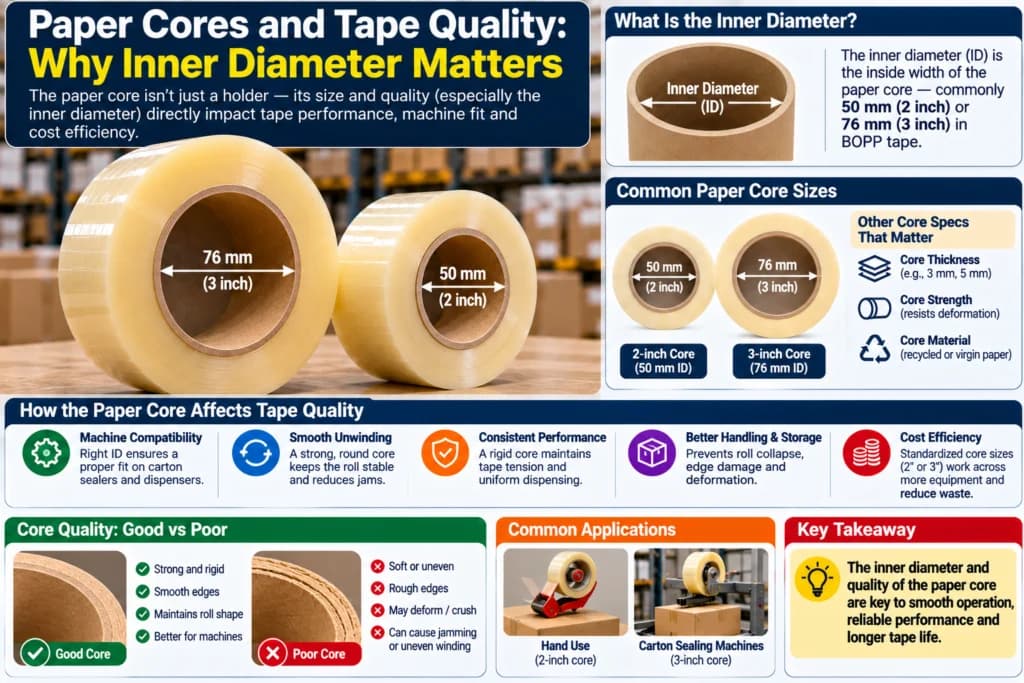
Most buyers look at tape the same way they look at a carton: adhesive, micron, width, colour. The paper core underneath gets no attention at all until it causes a problem on the line. By then the roll is already in the customer’s warehouse and the complaint is coming back to us, not to the core supplier.
We make our own cores in-house for this reason. It is not a cost-saving move. It is a quality control move. Here is why the core matters more than most buyers think.
What inner diameter consistency actually means
A standard BOPP tape core has a 3 inch inner diameter, roughly 76mm, built to sit on a 1 inch mandrel shaft used in most tape dispensers and slitting machines. That number sounds fixed, but in practice there is tolerance involved. If the core is wound even half a millimetre too tight or too loose across a batch, you get rolls that either jam on the mandrel or spin loose and wobble.
A core that is slightly oval, not perfectly round, causes the same trouble even if the average diameter is correct. This happens when the winding tension is uneven during core manufacturing. The core looks fine sitting on a table. It only shows its fault once it is loaded onto a spindle and spinning at speed.
- Too tight: the roll will not seat properly, operators have to force it, and the mandrel can scuff or crack the core.
- Too loose: the roll slips on the shaft, which throws off tension and causes uneven unwinding.
- Out of round: vibration during dispensing, especially on automated taping machines running at higher speeds.
None of this is visible to a buyer opening a carton of tape rolls. It only shows up once the roll goes onto a machine.
Telescoping and why it starts at the core
Telescoping is when the layers of a tape roll shift sideways, so the roll looks like a staggered cone instead of a flat cylinder. Buyers usually assume this is a winding fault in the tape itself, and sometimes it is. But a surprising amount of telescoping actually starts with the core.
If the core is not perfectly straight, or if its wall thickness is uneven around the circumference, the tape wound onto it inherits that irregularity. As the roll builds up layer after layer, a small core defect gets magnified. By the time the roll reaches its final diameter, what started as a half-millimetre wobble on the core can show up as several millimetres of edge misalignment on the finished roll.
This matters most on automatic and semi-automatic carton sealing machines. A telescoped roll does not sit square on the holder, it drags unevenly, and the tape can tear or skip instead of applying cleanly. On a manual dispenser it is just an annoyance. On a production line running hundreds of cartons an hour, it is downtime.
What happens on the slitter when cores are inconsistent
We run precision slitting on jumbo rolls to cut down to the width a customer orders, whether that is a 48mm carton sealing tape or a narrower stationery size. The slitting process depends on the mother roll’s core being dead straight and properly sized, because the whole roll spins on that core at speed during the cut.
If the core has any flex or runout, that gets transferred into the slit rolls. You end up with rolls that look fine individually but do not perform consistently once a customer starts unwinding them. Worse, an inconsistent core on the input side of a slitter can cause the whole roll stack to shift during cutting, which throws off width accuracy across the batch, not just on one roll.
This is also why core quality matters more as roll width increases. A narrow 12mm roll is more forgiving. A jumbo roll at 1000mm width with a weak or inconsistent core will visibly sag or deform under its own weight if the core cannot hold the load evenly.
Why winding our own cores helps
We wind paper cores in-house at our Mundka facility rather than buying them in from a separate core supplier. There are a few practical reasons this improves consistency:
- Matched tension control. The same team that controls tape winding tension also controls core winding tension, so the two processes are calibrated against each other rather than treated as unrelated inputs.
- Immediate feedback. If a batch of cores is coming out slightly off-spec, we see it on our own slitting line within the same shift, not weeks later when a customer complaint comes back from the field.
- No waiting on outside supply. Core quality does not depend on a third party’s production schedule or raw paper batch variation that we cannot inspect ourselves.
- Consistent wall thickness. We can control the paper layers and glue lamination in the core itself, which affects both rigidity and inner diameter accuracy.
This does not mean every core from every manufacturer is bad. Plenty of outside core suppliers do solid work. But when a tape manufacturer also controls the core, there is one less variable sitting between the raw material and the roll that ships out the door.
What to check as a buyer
You do not need a lab to spot a poor core. A few practical checks work fine on arrival:
- Roll the tape roll on a flat table. If it does not roll smoothly in a straight line, the core or the winding is off.
- Check that the roll seats on your mandrel or dispenser without forcing it or wobbling loosely.
- Look at the cut edge of the core itself for visible waviness or soft, crushed spots.
- If you run high-speed taping machines, ask your supplier directly whether they wind cores in-house or source them out.
The core is a small part of the total cost of a tape roll, but it decides whether that roll behaves predictably on your equipment. It is worth asking about even if nobody else on the floor thinks to mention it.
Your product, our package
Send us your requirement
Widths, colours, artwork, monthly volume: share what you need and we will come back with a price and a date.