
Packaging Guides
Packing Tape for Furniture and Heavy Goods: Getting the Spec Right
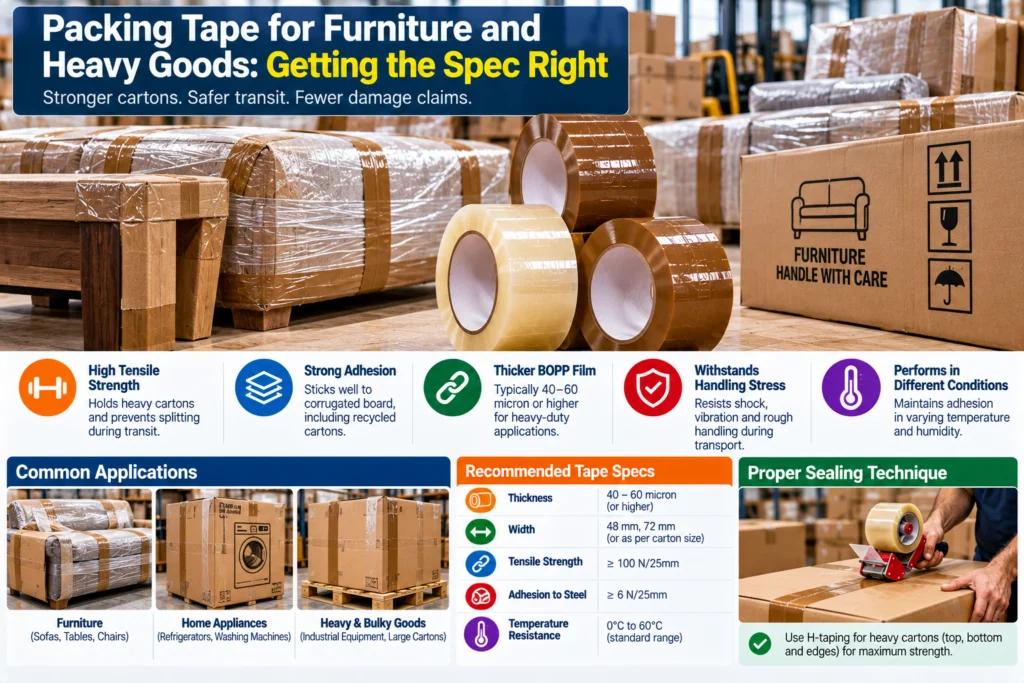
Furniture and heavy goods are a different packaging problem than e-commerce parcels or FMCG cartons. The boxes are bigger, the corners take more abuse, and the load on the seal is constant from the moment it is sealed to the moment it is opened. A tape that works fine on a 2 kg shipper will not hold up on a 25 kg carton going through three transshipment points. This article looks at what actually changes when you move from light cartons to heavy ones, and what to check before you place an order.
Why standard specs fall short
Most buyers default to 45 micron tape because it is the common e-commerce standard. For light to mid-weight cartons this is correct. But furniture parts, machinery components, appliance boxes, and bulky FMCG cartons put far more stress on a seal than a shoe box does. The weight pulls on the flaps, the box flexes during handling, and if the carton is oversized, the tape has to bridge gaps and uneven surfaces. A seal that looks fine on the day of packing can open up after a week in a truck.
Three things change for heavy goods: the micron thickness needed, the width of tape used, and how many wraps or passes go on each carton. Getting any one of these wrong usually shows up as a damaged or opened box at delivery, not at the loading dock.
Thickness: why 50-60 micron is the usual floor
For cartons in the 15-30 kg range with normal handling, 50 micron tape is a reasonable starting point. It carries enough adhesive and film strength to hold flaps under sustained load without stretching or lifting at the edges. For heavier cartons, repeated handling, or long-distance transit where the carton gets loaded and unloaded multiple times, 60 micron or higher is worth the extra cost. The thicker film resists puncture from corners, straps, and forklift contact, and it holds its tensile strength better when the box flexes.
Going thinner to save on tape cost is a false saving here. A seal failure on a heavy carton usually means a damaged product, a return, and sometimes a customer complaint that costs far more than the tape would have.
Width matters more than people expect
A lot of buyers only think about micron thickness and skip width. For heavy cartons, width is just as important. A 48mm tape is standard for most sealing jobs, but on large or heavy cartons, 72mm or even custom-slit wider tape gives a much larger bonding surface across the flap. This spreads the load over more adhesive contact area instead of concentrating stress on a narrow strip. Wider tape also tolerates slightly uneven carton edges better, which matters on furniture boxes that are not always perfectly square.
Sonison slits jumbo rolls down to the width a customer actually needs, from narrow reinforcement strips up to wide formats for big cartons. If your current sealing width is 48mm and you are seeing edge lift on heavy boxes, moving up to a wider tape is often a simpler fix than switching adhesive type.
Multiple wraps and the H-seal pattern
For furniture and heavy goods, a single strip down the centre seam is rarely enough. The standard approach for heavier cartons is the H-seal: one strip along the centre seam, plus perpendicular strips at each end running over the edges and partway down the sides. This locks the top and bottom flaps together instead of relying on the centre seam alone to hold under load.
For very heavy or irregular cartons, some packers add a full wrap around the carton body in addition to the H-seal, especially where the box will be handled by the flaps or lifted by straps. Each wrap adds holding strength, but it also adds cost and time on the line, so it is worth matching the pattern to the actual weight and handling risk rather than over-packing every carton the same way.
Corner protection is a separate decision
Tape seals the box, it does not protect the corners. Furniture cartons in particular take corner impact during loading, stacking, and transit, and tape alone will not stop a crushed corner or a puncture. Corner protection, whether cardboard angle boards, foam corners, or edge protectors used with strapping, should be treated as a separate line item from the tape spec. Where corner protectors are used, tape still needs to hold the carton closed independently. The two jobs are not interchangeable.
What to check before ordering
- Carton weight range: confirm the heaviest cartons in a batch, not just the average
- Transit handling: single leg delivery or multiple transshipment points
- Carton size and flap length: longer flaps may need wider tape or additional wraps
- Storage duration: cartons sitting in a warehouse for weeks need tape that holds adhesion over time, not just on the day of sealing
- Current failure pattern: if seals are opening at the edges, width is likely the issue; if tape is tearing, micron thickness is likely the issue
Matching the spec to the load
There is no single correct tape for all furniture and heavy goods, because carton weights and transit conditions vary too much. A 20 kg carton going on a single local delivery route does not need the same spec as a 35 kg carton going through multiple handling points over several days. The practical approach is to look at the heaviest and roughest case in a batch, spec the tape for that, and apply it consistently rather than guessing per carton.
Sonison manufactures BOPP tape in the 50-60 micron and 65+ micron range in widths up to 1320mm on jumbo rolls, slit down to whatever width a customer’s sealing equipment or hand-taping process needs. If you are dealing with recurring damage on heavy cartons, sending a sample carton spec, typical weight, and transit route is usually enough to work out whether the fix is thickness, width, or wrap pattern.
Your product, our package
Send us your requirement
Widths, colours, artwork, monthly volume: share what you need and we will come back with a price and a date.