
Packaging Guides
Monsoon Humidity and Carton Tape: Why Adhesion Drops and What to Do
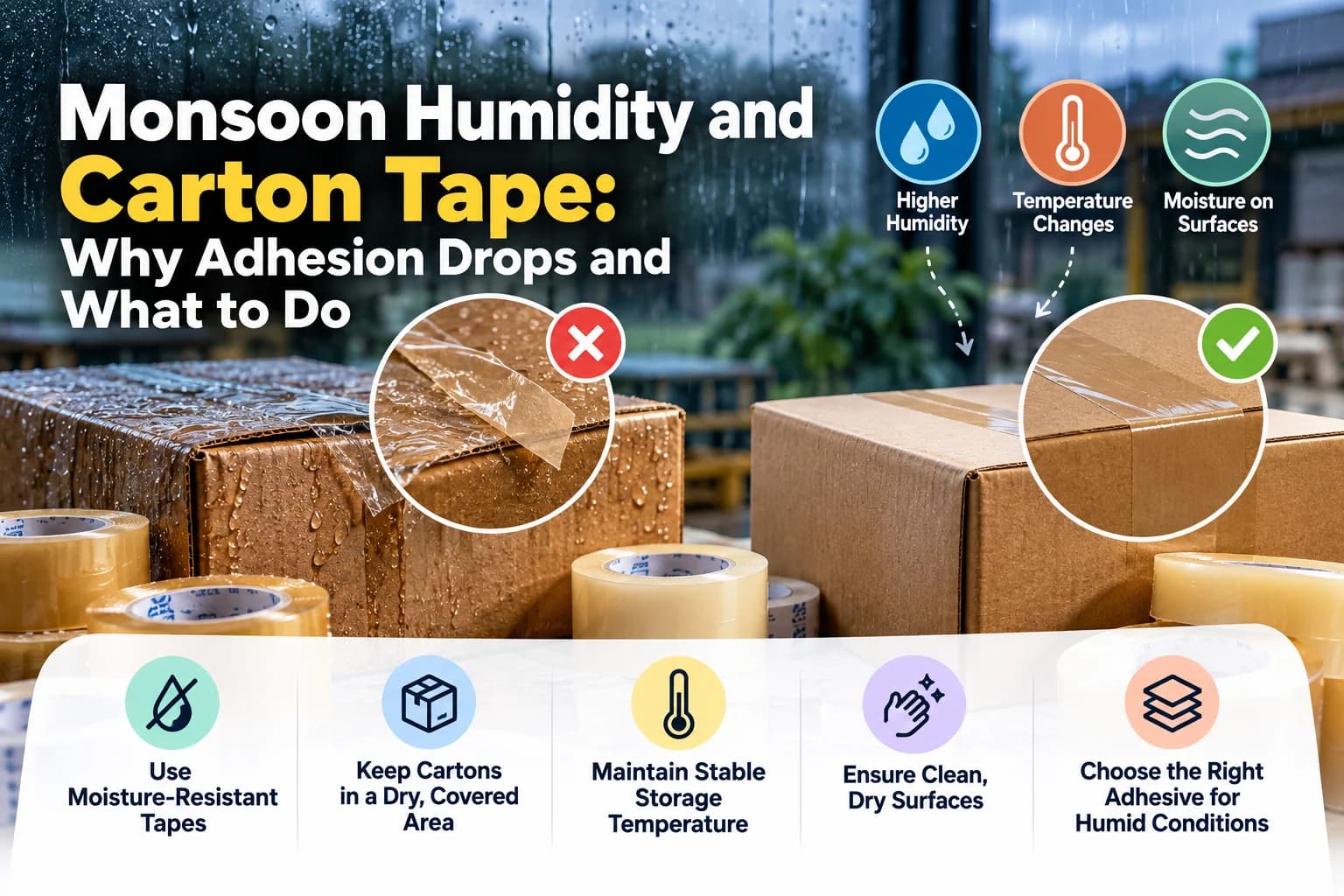
Every year around June, we get calls from warehouse managers asking why tape that worked fine in April is now failing on the same cartons. Flaps lifting at the corners, tape peeling off during transit, cartons arriving half open. Nothing changed in their process. What changed is the air.
What humidity actually does to adhesion
BOPP self-adhesive tape works because the acrylic adhesive layer bonds to the carton surface and to itself when overlapped. That bond depends on the adhesive staying tacky enough to wet out the surface it touches, and on the carton surface being dry enough to accept that bond.
During monsoon, two things work against this at the same time:
- Corrugated board absorbs moisture from the air. Kraft paper is hygroscopic. In humid conditions it can pick up moisture even in a closed warehouse, especially if cartons are stacked near open shutters or loading bays. Damp fibre surfaces don’t accept adhesive the same way dry fibre does.
- Water-based acrylic adhesive behaves differently in high humidity. The adhesive needs to release its water content and set properly after application. In a humid, low-airflow environment, that setting process slows down, so the tape may feel tacky at the point of sealing but not build full bond strength over the following hours.
The result is tape that looks applied correctly but fails a day or two later, often after the carton has already left the dock.
Why this shows up more on some cartons than others
Not every load fails the same way. A few patterns we see repeatedly:
- Recycled or lower-GSM board absorbs moisture faster than virgin kraft, so it shows adhesion problems sooner.
- Cartons stored outdoors or under tin sheds pick up ambient humidity even if not directly rained on.
- Loads travelling by open truck or through multiple transit points face repeated humidity swings, not one exposure.
- Cold-chain and FMCG cartons that go from air-conditioned storage to humid loading bays face condensation on the box surface itself, which is worse than general humidity.
If your rejection or complaint rate rises specifically between June and September, this is usually the reason, not a sudden drop in tape quality.
Why some businesses switch tape grade for the season
A straightforward response we see from experienced packaging teams is to move up in micron thickness for the monsoon months, then move back down afterward. Thicker film carries a heavier adhesive coat, which gives more margin when the adhesive isn’t setting at full efficiency. A carton sealed with 45 micron tape in dry conditions might need 50 or 60 micron during monsoon to get the same effective hold.
This isn’t about the film being weaker in humidity, BOPP film itself doesn’t absorb moisture the way paper does. It’s about giving the adhesive more surface area and more coat weight to work with when conditions are against it. A heavier tape also tends to apply more even pressure across the seal during hand or machine taping, which helps compensate for a less-than-ideal carton surface.
Exporters and businesses shipping through multiple humid ports often stay on 65 micron or higher year-round rather than switching, since their cartons face repeated handling and long transit regardless of season. But for domestic e-commerce and FMCG movement, where 35-40 or 45 micron is normal for most of the year, bumping up for four monsoon months is a common practical adjustment.
Practical steps beyond just the tape
Switching grade helps, but it isn’t the only lever. A few things worth checking on the floor:
- Keep cartons dry before sealing. Store flattened boxes away from shutters, loading bays, and anywhere rain can blow in, even under a roof.
- Apply tape with firm pressure. A hand dispenser or tape gun that presses the tape down properly matters more in humid conditions, since the adhesive needs help making contact.
- Don’t stack and move sealed cartons immediately. Give the adhesive a few minutes to start setting before cartons go into a tight stack or straight onto a humid dock.
- Check the H-seal, not just the top. Corners and edges are where lifting starts first in humid conditions, reinforce these if your product is heavy or the transit is long.
What we do differently for monsoon orders
We manufacture across the 35 to 65+ micron range, coated with water-based acrylic adhesive on our own coating line in Mundka. When customers place monsoon-season orders, we’re used to the conversation about stepping up a grade, and we can advise based on what carton weight and transit route you’re dealing with, without pushing you to over-spec for the rest of the year.
If you’re not sure whether your current tape needs a seasonal change, the simplest test is to seal a few cartons with your existing grade and one grade heavier, leave them in your actual storage conditions for 48 hours, and check the corners. The difference is usually visible without any lab equipment.
Your product, our package
Send us your requirement
Widths, colours, artwork, monthly volume: share what you need and we will come back with a price and a date.