
Packaging Guides
Mini Jumbo Rolls: Specs and Who Actually Buys Them
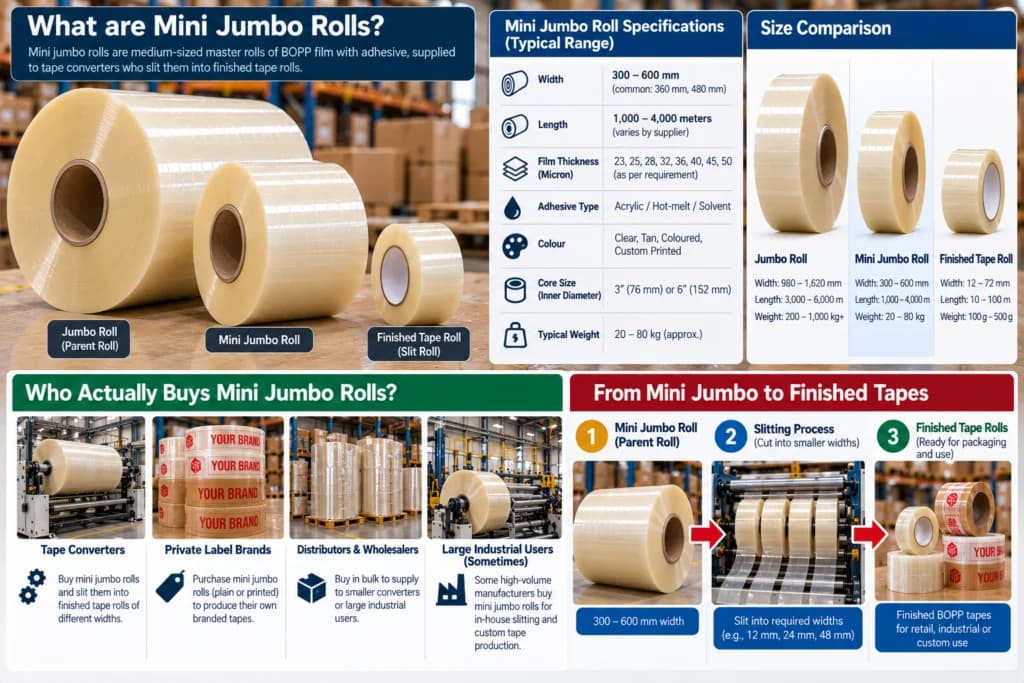
Ask three people in the tape trade what a “mini jumbo roll” is and you will get three slightly different answers. That’s because the term sits in the middle ground between a full jumbo roll and a finished, ready-to-use tape roll. This article explains where mini jumbo rolls fit, what sizes they typically come in, and who actually buys them instead of going straight for jumbo rolls or finished rolls.
Where mini jumbo rolls fit in the production chain
A BOPP tape production line usually works in three stages. First, a coating machine applies water-based acrylic adhesive to a wide BOPP film and winds it into a jumbo roll, sometimes called a mother roll. These can run anywhere from 1000mm to 1320mm in width and hold several thousand metres of film.
Second, that jumbo roll gets slit down. If it’s slit all the way to finished widths like 48mm or 72mm, ready for a tape dispenser gun, that’s the final retail-style roll. But there’s a middle step many buyers want: slitting the jumbo roll into mini jumbo rolls, which are narrower than the mother roll but still wider than a finished tape roll, and still wound to a longer length than a typical retail roll.
In short: jumbo roll is the biggest format, mini jumbo roll is the mid-size format, and the small roll you see on a packing table is the final format. Mini jumbo rolls exist because not every buyer wants, or can handle, a full-width mother roll.
Typical specs for mini jumbo rolls
At Sonison, our jumbo and mini jumbo rolls run in the 192mm to 1320mm width range, depending on what the customer is ordering and what downstream use is planned. Within that range, mini jumbo rolls commonly fall between 192mm and 500mm width, though this varies by manufacturer and by what the buyer’s own slitting machine can handle.
Length per roll is usually higher than a finished tape roll because the core diameter and roll build are designed for a slitting operation, not for a hand dispenser. A typical finished roll might run 65 or 100 metres. A mini jumbo roll built for re-slitting can carry several hundred metres to a few thousand metres depending on micron thickness, since thinner film packs more length onto the same roll diameter.
Micron range stays the same across jumbo, mini jumbo, and finished rolls, because the film and adhesive coating happen before slitting. So you’ll still see 35-40 micron for light loads, 45 micron for standard e-commerce and FMCG cartons, 50-60 micron for heavier cartons or longer transit, and 65 micron plus for export and repeated handling.
Who buys mini jumbo rolls instead of full jumbo rolls
Full jumbo rolls at 1000mm or wider are mainly bought by converters and slitting houses that have their own slitting machines capable of handling that width, and the volume to justify it. If you’re processing tens of thousands of metres a month and have the machinery, a full jumbo roll is the most cost-efficient raw format because you’re not paying for someone else’s slitting step.
Mini jumbo rolls serve a different buyer:
- Smaller slitting operations that have narrower slitting machines and can’t feed a 1000mm+ roll, but still want to do their own final cutting to custom widths.
- Traders and distributors who stock mini jumbo rolls and slit or resell them in smaller batches to local packaging shops, rather than committing to full jumbo volumes.
- Printers and converters working on custom printed tape runs where the order quantity doesn’t justify running a full jumbo width, so a mid-width roll keeps the print job manageable.
- Mid-size manufacturers who want more flexibility to switch between a few different finished widths without storing several full jumbo rolls at once.
Essentially, mini jumbo rolls let a buyer skip the cost and machinery requirement of a full jumbo roll, while still buying in bulk rather than finished, retail-ready rolls.
Why the distinction matters when you place an order
If you tell a supplier you want “jumbo rolls” without specifying width, you might get quoted on a size your machine can’t handle, or a quantity that doesn’t match your storage space. Being specific about whether you need a mini jumbo roll or a full jumbo roll, and giving your slitting machine’s maximum width, saves a round of back-and-forth on the order.
It also affects pricing per metre. Full jumbo rolls are generally the cheapest per metre of film because they skip an extra slitting pass. Mini jumbo rolls cost a bit more per metre since they’ve already gone through one slitting operation at the manufacturer’s end. Finished retail rolls cost the most per metre because they’ve gone through the full process, including core insertion and roll packing for individual sale.
What to confirm before ordering
When ordering mini jumbo rolls, confirm four things with your supplier: the exact width range your own machine can accept, the micron thickness suited to your product weight and transit length, the core inner diameter your winding or slitting setup uses, and the length per roll you need for your batch planning. Getting these four details right up front means the rolls arrive ready to run on your line without rework.
At our facility in Mundka, we coat, print, and slit under one roof, which means we can produce mini jumbo rolls to the width and length a customer’s own machinery needs, rather than forcing every order into one standard size.
Your product, our package
Send us your requirement
Widths, colours, artwork, monthly volume: share what you need and we will come back with a price and a date.