
Packaging Guides
Local Tape Supplier or Large Manufacturer: What Actually Changes
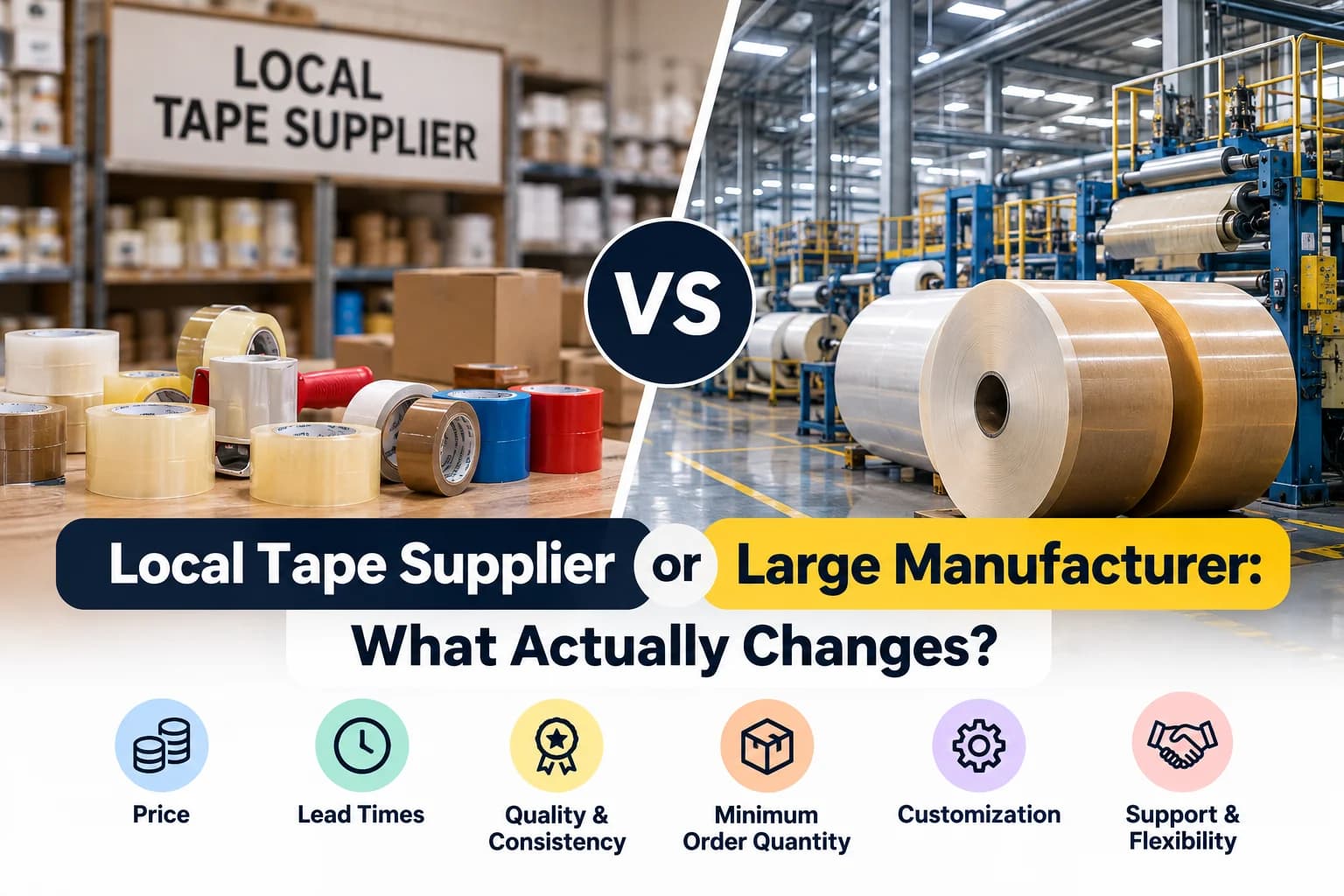
Every packaging manager buying tape in bulk hits the same fork in the road at some point. Do you stay with the local trader who has supplied you for years, or move to a larger manufacturer who can quote a lower per-roll price but wants a bigger order upfront? There is no universal right answer here. It depends on your volume, your storage space, and how predictable your demand actually is.
This article lays out the real trade-offs, without pretending one side always wins.
Price: where the numbers actually diverge
Local suppliers, often traders who buy in bulk from a manufacturer and resell in smaller lots, add a margin for that service. You pay more per roll, sometimes 10-20% more, because they are carrying inventory risk and breaking bulk for you.
A manufacturer selling direct cuts out that layer. Coating, printing, and slitting all happen under one roof, so the cost per roll drops as order size goes up. But that lower price only shows up at volume. A small order placed directly with a manufacturer can actually cost more per roll than buying from a local trader, because the manufacturer has to set up the line for a short run and the fixed costs get spread over fewer rolls.
The practical rule: if your monthly requirement is under a few hundred rolls, a local supplier’s blended pricing is often competitive. Above that, direct sourcing from a manufacturer starts to pay off.
Minimum order size: the real constraint
This is where most first-time buyers get surprised. A local trader will usually sell you 10 rolls, 50 rolls, whatever fits your current need. A manufacturer, especially one running rotogravure printing for custom branded tape, works in cylinder-based batches. Once a print cylinder is made for your logo, it makes sense to run enough tape to justify that cost. Plain or brown tape has a lower MOQ since there is no cylinder involved, but jumbo roll production still runs in batches tied to slitting schedules.
If your business ships 200 cartons a month, chasing a large manufacturer’s MOQ for custom printed tape can mean tying up capital in stock you will take eight months to use. In that case, a local supplier who can sell you smaller printed batches, even at a slightly higher rate, is the more sensible choice. If you are moving thousands of cartons a month, the MOQ stops being a problem and becomes simply your normal order size.
Turnaround time: not always what you expect
People assume local always means faster. That is true for emergency top-ups: a local supplier five kilometres away can hand over rolls the same afternoon. A manufacturer producing to order needs lead time for coating, curing, printing, and slitting, which for a large order can run one to two weeks depending on micron and width.
But steady-state, that assumption flips. A manufacturer who knows your monthly consumption and production calendar can plan a batch in advance and have it ready to dispatch on schedule, often faster than a trader waiting for their own upstream supplier to have stock. Local suppliers are strong for one-off urgent needs. Manufacturers are strong for planned, recurring volume.
Other factors that quietly matter
- Quality consistency: A trader’s stock can come from different manufacturers batch to batch, so coat weight and peel strength can shift without warning. Buying direct from one manufacturer keeps the adhesive formulation and micron specification consistent across orders.
- Customisation: Coloured tape, custom printing up to three colours, and specific micron ranges (35-40 for light parcels, 45 for standard e-commerce, 50-60 for heavier cartons, 65+ for export) are easier to specify directly with a manufacturer who controls the coating line. A local trader can only offer what is already sitting in their warehouse.
- Working capital: Bulk orders from a manufacturer tie up cash and warehouse space. If storage is tight, smaller, more frequent local orders may suit your operation better even at a slightly higher unit cost.
- Relationship over time: A manufacturer you deal with directly can flag issues in tension, adhesive, or slitting before they become returns, because they made the roll. A trader is a pass-through and cannot troubleshoot production issues.
A practical way to decide
Work out your actual monthly consumption in rolls, not cartons or metres. Then ask three questions:
- Is my monthly requirement above or below the manufacturer’s stated MOQ for the tape type I need (plain, coloured, or printed)?
- Can I forecast my usage two to four weeks ahead, or does my ordering happen on short notice?
- Do I have space to hold a month or two of stock, or am I ordering hand to mouth?
If your volumes are steady and above MOQ, and you can plan a couple of weeks ahead, a direct manufacturer relationship usually saves money and improves consistency. If your orders are small, irregular, or urgent, a local supplier remains the more practical fit.
A middle path many buyers use
Some buyers split the difference: they place their base recurring order directly with a manufacturer at a planned interval, and keep a local supplier as a backup for emergency top-ups between deliveries. This gives the price benefit of bulk direct sourcing without the risk of running out of tape on a production day.
Whichever way you go, ask for sample rolls first and check the specification sheet against what actually arrives. That single step avoids most of the disappointment people associate with switching suppliers, regardless of whether the new one is local or large.
Your product, our package
Send us your requirement
Widths, colours, artwork, monthly volume: share what you need and we will come back with a price and a date.