
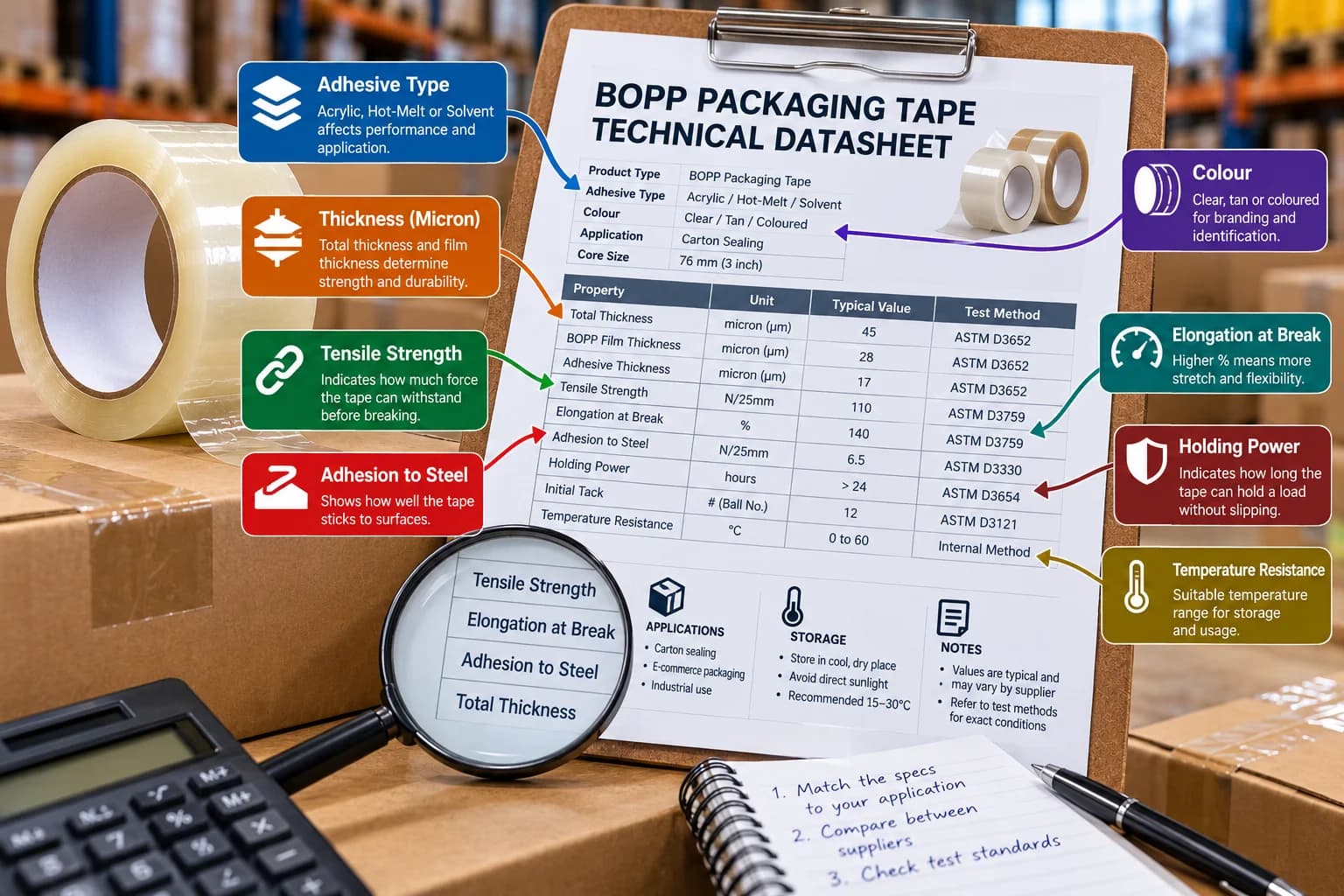
Every roll of BOPP tape comes with a datasheet attached somewhere, either printed on the box, sent by email, or handed over by the sales team. Most buyers glance at the micron number, maybe check the width, and move on. That leaves a lot of useful information unread, and some of it tells you more about tape quality than the micron figure does.
This article walks through the datasheet line by line: coat weight, elongation at break, and thickness tolerance. These three numbers, read together, tell you whether a tape is actually consistent or just looks good on paper.
Start with coat weight, not just micron
Micron tells you the total thickness of the tape, film plus adhesive. Coat weight tells you how much adhesive is actually sitting on that film, usually expressed in GSM (grams per square metre).
Two tapes can both be labelled 45 microns and still behave very differently if one has 18 GSM of adhesive and the other has 22 GSM. More adhesive generally means better initial tack and stronger bonding on rough or dusty carton surfaces. Less adhesive means the tape feels thin on the roll and may not hold well on uneven board.
As a rough guide for carton sealing tape:
- 16-18 GSM: light duty, fine for small, light cartons with short transit
- 20-22 GSM: the range most e-commerce and FMCG tape sits in
- 24 GSM and above: heavier cartons, rough surfaces, or export loads that get handled multiple times
If a datasheet does not mention coat weight at all, ask for it. A supplier who tracks coat weight is running a coating line with proper controls. A supplier who only quotes micron may not be measuring adhesive application closely.
Elongation at break: what it actually tells you
Elongation at break is the percentage a tape stretches before it snaps, tested by pulling a sample until it tears. For BOPP tape this number usually falls somewhere between 100% and 180%, depending on the film formulation.
A lot of buyers skip this figure because it sounds like a lab test with no practical use. It matters more than people think, for two reasons.
First, it predicts behaviour during application. Tape with very low elongation feels stiff and snaps unexpectedly on the dispenser, especially at higher taping speeds on a machine line. Tape with reasonable elongation flexes slightly as it goes around carton edges and corners without cracking.
Second, it predicts behaviour under stress after sealing. Cartons get dropped, stacked, and compressed in transit. A tape with some elongation absorbs a bit of that shock instead of tearing immediately. A tape with very low elongation can crack along the seal line when the carton flexes, which opens the seam.
For general carton sealing, elongation in the 120-160% range is a reasonable working number. Below 100% usually means the film is overly rigid or was stretched too much during manufacturing, which thins it unevenly and makes it brittle.
Thickness tolerance: the number that separates consistent tape from inconsistent tape
This is the figure most datasheets bury near the bottom, and it is arguably the most telling one. Thickness tolerance tells you how much the actual thickness can vary from the stated micron, usually written as a plus-minus percentage, like 45 microns ± 2 microns.
A tight tolerance means the slitting and coating process is well controlled. A wide tolerance means the roll you receive could be noticeably thinner than what is printed on the box, even if it is labelled correctly.
Why this matters practically: if you buy 45 micron tape with a tolerance of ±5 microns, you could be getting tape anywhere from 40 to 50 microns. At 40 microns, that tape is really a lighter-duty product sold at 45 micron pricing. Over a large order, that difference adds up in sealing performance and in how much tape you actually use per carton, since thinner tape sometimes needs more wraps to hold.
A tolerance of ±2 microns or tighter is a good benchmark for standard carton sealing tape. Anything wider than ±4 microns is worth questioning, especially on repeat orders where consistency matters more than a one-off purchase.
Reading the three numbers together
None of these figures mean much in isolation. A datasheet with high coat weight, reasonable elongation, and tight thickness tolerance describes a tape that will behave the same way roll after roll. A datasheet with good-sounding micron but vague or missing data on the other three is harder to judge, and that is usually the point, since it is easier to hide inconsistency behind a single headline number.
When comparing two suppliers quoting the same micron, ask for the full datasheet, not just the summary. Look at coat weight to judge adhesive strength, elongation at break to judge how the tape handles stress and cold temperatures, and thickness tolerance to judge how consistent the manufacturing process actually is.
What to ask your supplier
- What is the coat weight in GSM for this micron grade
- What is the elongation at break, and is it tested per batch or just at formulation stage
- What is the thickness tolerance, and how is it checked during slitting
A supplier running an in-house coating and slitting line should be able to answer these without hesitation, since the numbers come off their own production floor rather than a trading catalogue. If the answers are vague, that itself is useful information before you place a bulk order.
Your product, our package
Send us your requirement
Widths, colours, artwork, monthly volume: share what you need and we will come back with a price and a date.