
Packaging Guides
Does Tape Colour Affect Strength? Clear, Tan and Coloured BOPP
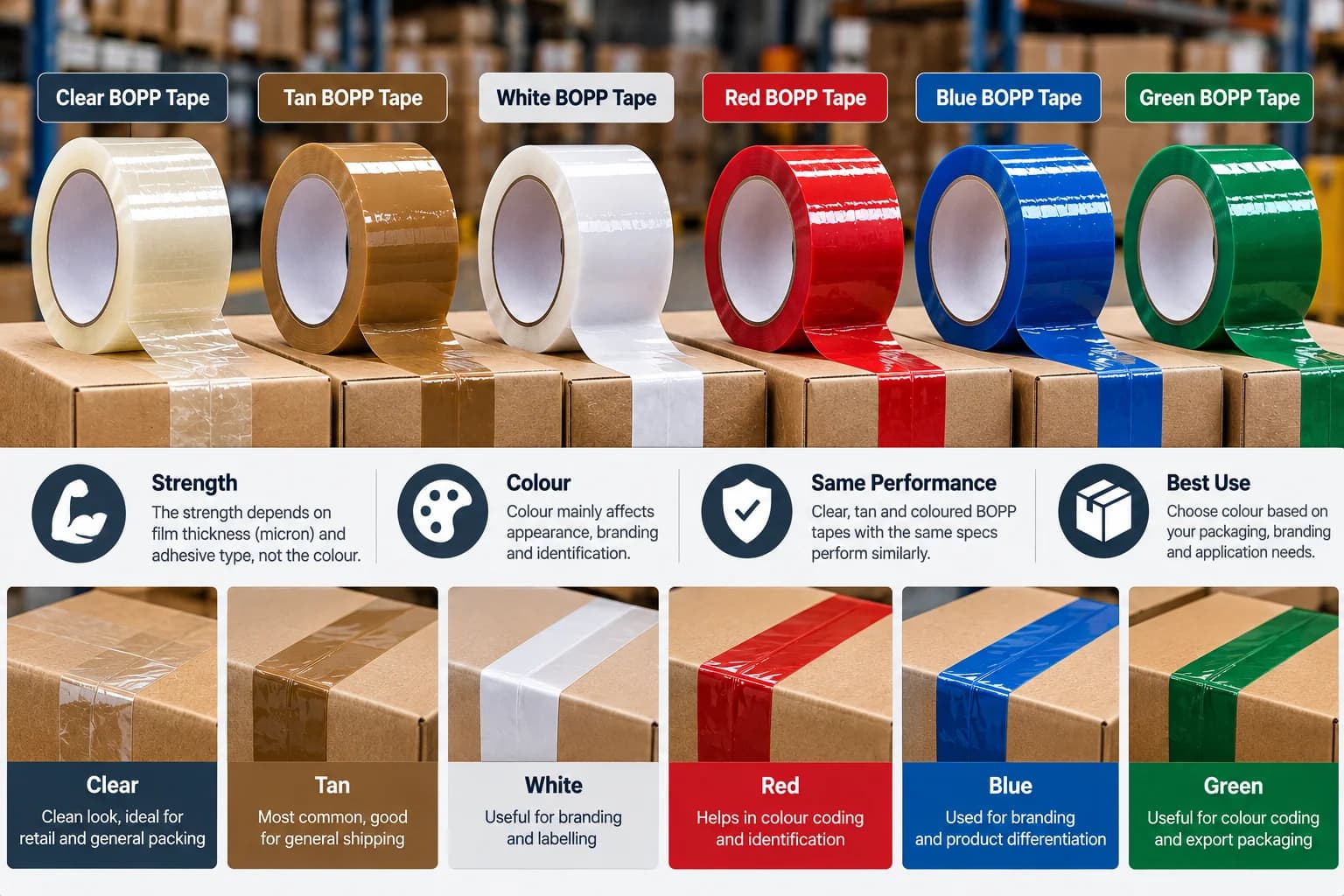
We get this question often enough that it is worth a straight answer: does the colour of BOPP tape change how well it sticks or how much weight it holds? The short answer is no, not in any way that matters on a carton. Colour is a surface treatment. Strength comes from the film and the adhesive underneath it. Let us walk through why, and where colour actually does matter.
What actually determines tape strength
A BOPP tape has two parts doing the real work:
- The BOPP film, which gives it tensile strength and resistance to tearing. This depends on the film’s thickness and how it is stretched during manufacturing, not on colour.
- The adhesive coating, usually water-based acrylic at our plant, which determines tack, peel adhesion, and how well it bonds to the carton surface over time.
Micron thickness (35-40 for light parcels, 45 for standard e-commerce, 50-60 for heavier cartons, 65+ for export and long storage) is what you should be matching to your carton weight and transit length. None of this changes when you switch from clear to tan to blue or red.
Where does the colour come from
Colour in BOPP tape comes from one of two places:
- Pigment masterbatch in the film, used for solid coloured tapes like brown, tan, red, yellow, or black. The pigment is mixed into the polymer at a small percentage, typically well under 5 percent of the film composition. It does not interfere with how the film is cast or stretched.
- Printing on a clear or tan base, used for custom printed tape with a logo or text in up to three colours. Here the base tape’s properties are unchanged, and only a thin rotogravure ink layer sits on top of the film, away from the adhesive side entirely.
In both cases, the adhesive is coated separately, after the film is formed or tinted. The acrylic coating process does not care what colour the film underneath is. Peel adhesion, shear strength, and tack are controlled by adhesive formulation and coating weight, not by the pigment in the film.
Common myths worth clearing up
“Tan tape is stronger than clear tape”
Not true by default. Tan tape became the default for cartons mostly because it is the natural colour of lower-cost BOPP film and is cheap to produce in bulk, not because it carries more adhesive or film strength. You can get tan tape in 35 micron or 60 micron, exactly as you can with clear.
“Coloured tape is weaker because of the dye”
Also not true. The pigment load is small enough that it does not meaningfully change the film’s tensile properties. If a coloured tape performs worse, it is almost always because it was made to a lower micron or with a lower grade adhesive to cut cost, not because of the colour itself. Always check the micron and adhesive type, not the shade.
“Clear tape is premium, coloured is downgraded”
Clear tape is popular for e-commerce because it lets barcodes and labels underneath stay visible and gives cartons a clean look. That is a packaging preference, not a strength advantage.
When colour is actually useful: coding
Where colour genuinely earns its place is in warehouse and logistics coding. Some practical uses we see from customers:
- Return vs fresh stock: one colour for outbound cartons, another for returns processing, so staff can sort visually without opening boxes.
- Destination or route coding: different colours for different zones or depots in a distribution network.
- Quality or batch marking: a colour change signals a different production batch or inspection status on the floor.
- Product category separation: footwear and apparel exporters sometimes use colour to separate SKUs or size runs at the packing table.
In all these cases, the colour is doing a job for your operations team, not for the customer. You are choosing a shade for visibility and quick recognition, and any micron or adhesive grade can be produced in that colour.
When colour is for branding
Branding is a separate decision. A coloured base tape with your logo printed on it, or a clear tape with printed branding, is about what the customer sees when the parcel arrives. This is where custom printed tape comes in, usually clear or tan as the base with up to three colours printed via rotogravure. Here you are choosing colour and print for brand recall, not for strength or coding, and the structural performance of the tape should be specified separately based on your carton weight and transit conditions.
What to actually specify when ordering
When you place an order, keep colour and performance as two separate conversations:
- Pick the micron based on your carton weight and how long the parcel will be in transit or storage.
- Confirm the adhesive is suited to your conditions, standard acrylic for most e-commerce and FMCG, a stronger formulation if cartons face heat, cold storage, or long dwell time.
- Then choose colour separately, based on whether you need it for internal coding, customer-facing branding, or simply what is in stock and cost-effective.
If a supplier tells you a particular colour is “stronger” or “weaker” without talking about micron and adhesive type, that is a red flag that they are not specifying the tape properly. Ask for the micron and adhesive grade first, and treat colour as a separate, secondary choice.
Your product, our package
Send us your requirement
Widths, colours, artwork, monthly volume: share what you need and we will come back with a price and a date.