
Packaging Guides
Cutting Tape Waste on the Packing Floor: A Practical Guide
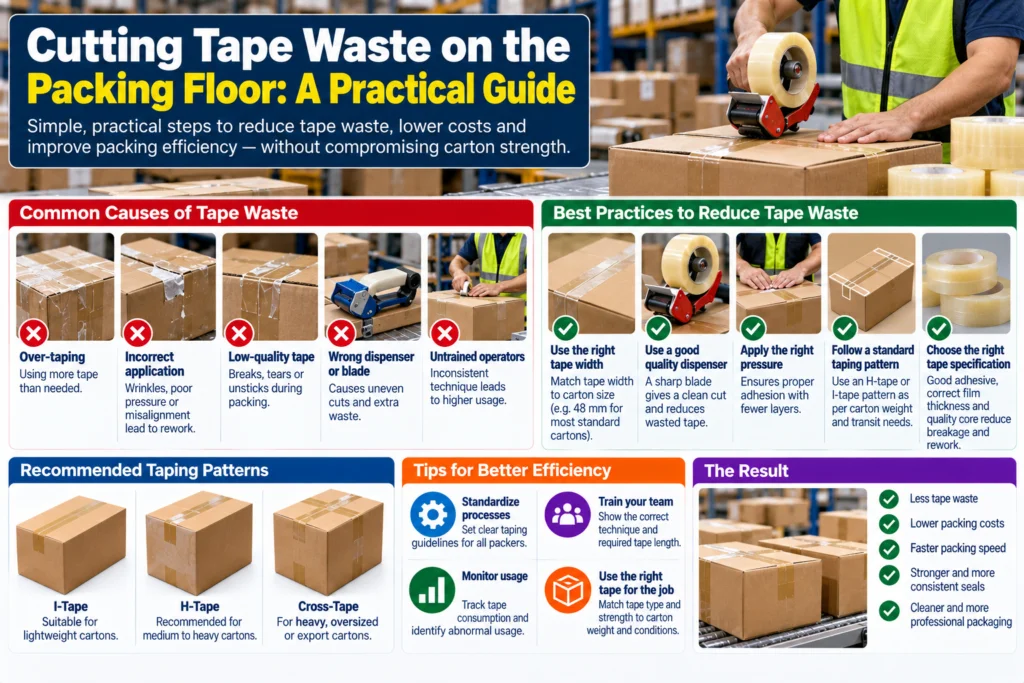
Every packing floor we visit has the same problem somewhere in the corner: a bin full of half-used tape rolls, torn ends, and offcuts that never made it onto a carton. Nobody plans for this waste. It builds up from small habits repeated thousands of times a day. The good news is that most of it is fixable without spending more on tape.
Where the waste actually comes from
We have walked enough packing lines to know the waste is rarely about tape quality. It usually comes from three places: wrong width for the carton, dispensers that are not set up properly, and operators wrapping cartons two or three times out of habit rather than need.
1. Right-sizing the width
A lot of warehouses standardise on one tape width, usually 48mm, and use it for every carton regardless of size. That works for medium and large boxes, but it is overkill for small e-commerce parcels or light footwear and apparel cartons. A 36mm or even 24mm width seals a small box just as well and uses noticeably less film and adhesive per seal.
At our facility we slit BOPP jumbo rolls down to widths between 192mm and 1320mm at the mother roll stage, which lets converters and buyers order narrower finished rolls matched to actual carton sizes instead of cutting down a wider roll on the floor, which itself generates waste.
If your SKU mix includes a lot of small cartons, it is worth auditing what percentage of your tape usage is going onto boxes smaller than standard. In our experience with FMCG and footwear packers, this is often 20 to 30 percent of total carton volume, and switching those lines to a narrower width cuts tape consumption on that segment by close to half.
2. Dispenser setup and training
A tape dispenser that is not adjusted correctly is one of the biggest silent causes of waste. Common issues we see on client floors:
- Tension set too loose: the tape stretches and snaps mid-application, and the operator pulls a fresh length to finish the job, wasting the torn piece.
- Blunt or misaligned blade: tears come out ragged, so the operator tears again, sometimes twice, before getting a clean cut.
- Wrong dispenser for the width: using a 48mm dispenser with 36mm tape causes the roll to wobble and unwind unevenly, leading to wrinkled, wasted lengths.
- Manual tearing instead of dispenser use: operators who skip the dispenser and tear tape by hand almost always pull more than needed because there is no fixed cutting point.
None of this requires new equipment in most cases, just a five-minute check per shift on tension and blade sharpness, and matching dispenser size to tape width. A short training session, even 15 minutes, on how to load the roll correctly and use the full width of the blade edge pays for itself within a week on most lines.
3. The double-wrap habit
This is the one we see most often and it has nothing to do with the tape itself. Operators who have been burned once by a carton coming open in transit start wrapping every carton twice, sometimes in a full loop around the box rather than just sealing the centre seam and the two end flaps. Over a shift of a few hundred cartons, this habit alone can double tape consumption for no real gain in seal strength.
The fix is not to tell operators to use less tape, because that ignores why the habit started. The real fix is to make sure the tape itself is doing its job so the extra wrap is not needed:
- Match the micron to the carton weight and transit length. A 35-40 micron tape is fine for light, short-transit parcels, but if operators are compensating for a tape that is too thin for the load, no amount of training will stop the double-wrapping.
- Check coat weight consistency. If peel strength varies across a roll, operators notice inconsistent sealing and start over-applying tape as insurance.
- For heavier cartons or longer transit, move up to 50-60 micron or 65+ for export and repeated handling, rather than layering standard tape twice.
Once operators trust that a single H-pattern or full-seam application will hold, the double-wrap habit tends to drop on its own, especially if a supervisor flags it directly during spot checks.
Putting a number on the savings
A mid-sized e-commerce or FMCG packer sealing 2,000 cartons a day on a mix of tape widths and micron grades can easily be using 15 to 25 percent more tape than the job needs, once oversized width, loose dispensers, and double-wrapping are added up. That is not a small number over a year, and it is addressable through specification and training rather than switching suppliers or compromising on seal strength.
A simple audit to run this week
- Pull tape usage records for the last month and compare against carton volume by size.
- Walk the floor and check dispenser tension and blade condition on every station.
- Watch five operators seal a carton each and count the number of tape applications per box.
- Ask operators directly why they double-wrap, since the answer usually points to a specific past failure.
Reducing tape waste is less about the roll and more about how it is specified, dispensed, and used on the floor. Get the width and micron right for the job, keep dispensers in working order, and give operators a reason to trust a single clean seal. The savings show up fast, and the cartons still arrive sealed.
Your product, our package
Send us your requirement
Widths, colours, artwork, monthly volume: share what you need and we will come back with a price and a date.