
Packaging Guides
Coat Weight Consistency: Why Peel Strength Varies Across a Roll
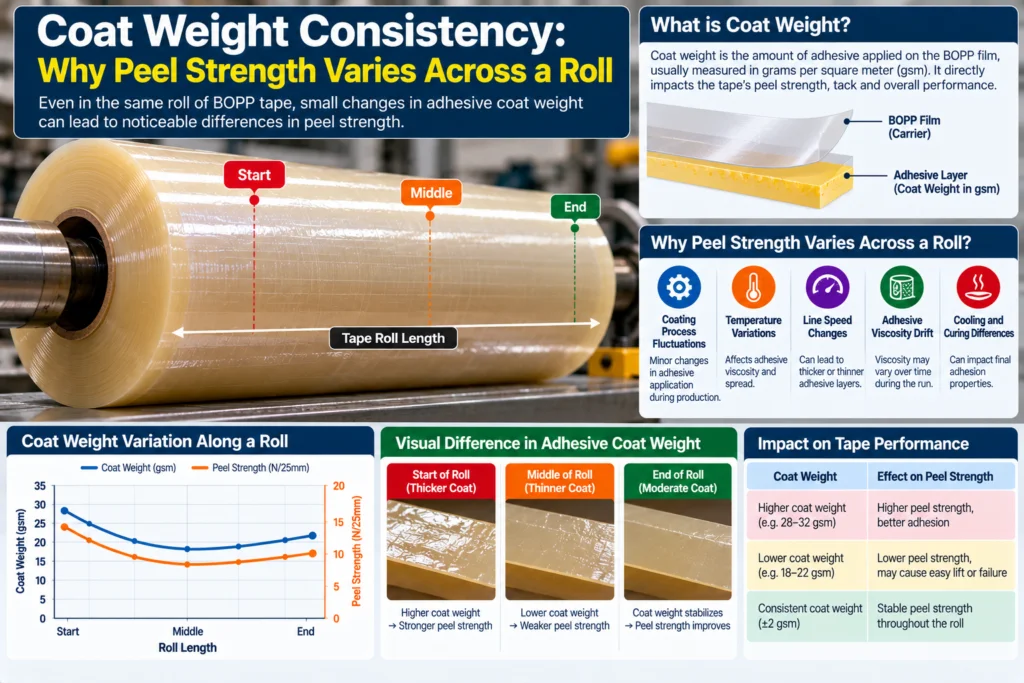
When a batch of tape passes the peel test and still fails on the floor, the first thing we check is coat weight consistency. Not adhesive type, not film grade, coat weight. It is the one variable that can make two rolls from the same batch perform completely differently, and most buyers never get told to look for it.
What coat weight actually means
Coat weight is the amount of adhesive applied per square metre of film, usually measured in grams per square metre (gsm). On our line, water-based acrylic adhesive is applied to BOPP film through a coating head, then dried in an oven before winding. The target coat weight depends on the product spec, but what matters more than the number itself is whether that number stays the same from the start of the roll to the end, and from edge to edge across the width.
A tape rated for a certain peel strength is only reliable if the adhesive laydown is even. If one section of the roll gets more adhesive and another gets less, you have one product with two different performance levels sitting on the same core.
How unevenness actually happens on a coating line
Coat weight does not usually go wrong because of bad raw material. It goes wrong because of small mechanical and process drifts that are easy to miss without checking:
- Coating gap drift: the gap between the coating roller and the film can shift slightly as the line runs, changing how much adhesive transfers.
- Viscosity change: as the adhesive bath sits and runs, viscosity can drift with temperature, pulling more or less adhesive onto the film.
- Web tension variation: if the film is not pulled through at constant tension, the adhesive spreads unevenly, thicker in some spots, thinner in others.
- Oven drying inconsistency: uneven drying across the width of the web can leave some sections slightly under-cured, which changes how the adhesive bonds even if the wet coat weight was fine.
- Roller wear: a worn or unevenly worn application roller lays down adhesive differently across its width, which shows up as a strip of weaker tape running the length of the roll.
None of these are dramatic failures. They are small drifts that a line without tight process control will simply carry through into the finished roll without anyone noticing until the tape is in someone’s hands.
How this shows up as peel strength problems
Peel strength is a direct measurement of how much force it takes to pull the tape off a surface. When coat weight is uneven, you do not get a tape that is simply “weaker overall.” You get a tape that is inconsistent, which is a different and often worse problem for a buyer.
In practice, this means:
- The first 200 metres of a roll seal cartons perfectly, but the middle section starts lifting at the flap edges within a day.
- Two cartons sealed back to back on the same packing line, with the same operator, behave differently because the tape pulled from slightly different points on the roll.
- A courier network stress test passes on a sample cut from the outer wind but fails on a sample from near the core.
- Cold storage or high-humidity cartons show adhesion failure in patches rather than uniformly, which is often misread as a humidity problem when it is actually a coating problem.
This is why a single peel test on a single sample is not enough to judge a batch. A tape can test fine and still have a weak stretch 300 metres into the roll that only shows up once it is actually used.
Why this matters more for some buyers than others
For light, short-transit packing, small coat weight variation rarely causes a visible problem because the margin for error is bigger. But for buyers running high volumes or demanding conditions, it matters a lot more:
- E-commerce and courier networks: cartons get handled multiple times, so a weak patch of tape is more likely to get tested by a real drop or scrape.
- Export shipments: long transit and multiple handling points mean there is no room for a roll with inconsistent seal strength partway through.
- Pharma and cold-chain: temperature cycling already stresses the adhesive bond, so any existing weak spot from uneven coating fails faster.
- High-speed FMCG lines: operators are not checking each metre of tape by hand, so an inconsistent roll just gets used as-is, with failures showing up downstream at the retailer or distributor.
What consistent coat weight actually requires
Keeping coat weight stable through an entire jumbo roll run comes down to process discipline more than equipment alone:
- Checking coating gap and roller condition regularly during a production run, not just at setup.
- Monitoring adhesive viscosity and topping up or adjusting rather than letting it drift over a long run.
- Keeping web tension steady through the coating and drying stages.
- Sampling peel strength at multiple points across a jumbo roll, not just at the start, before it is slit and dispatched.
At Sonison, coating, drying, and slitting all happen under one roof at our Mundka facility, which lets us check these points directly on the line rather than relying on a supplier’s word for it. It does not make every roll perfect, no process does, but it means problems get caught at the jumbo roll stage instead of getting discovered by a customer three weeks later.
What to ask your supplier
If you are buying in volume, it is worth asking a direct question: how is coat weight checked during a production run, and is peel strength tested at more than one point on a roll? A supplier running a tight coating line should be able to answer this without hesitation. If the answer is vague, that inconsistency you are seeing on the packing floor is probably not bad luck, it is a coating process that is not being watched closely enough.
Your product, our package
Send us your requirement
Widths, colours, artwork, monthly volume: share what you need and we will come back with a price and a date.