
Packaging Guides
Choosing BOPP Tape Micron: Match Gauge to Weight and Transit
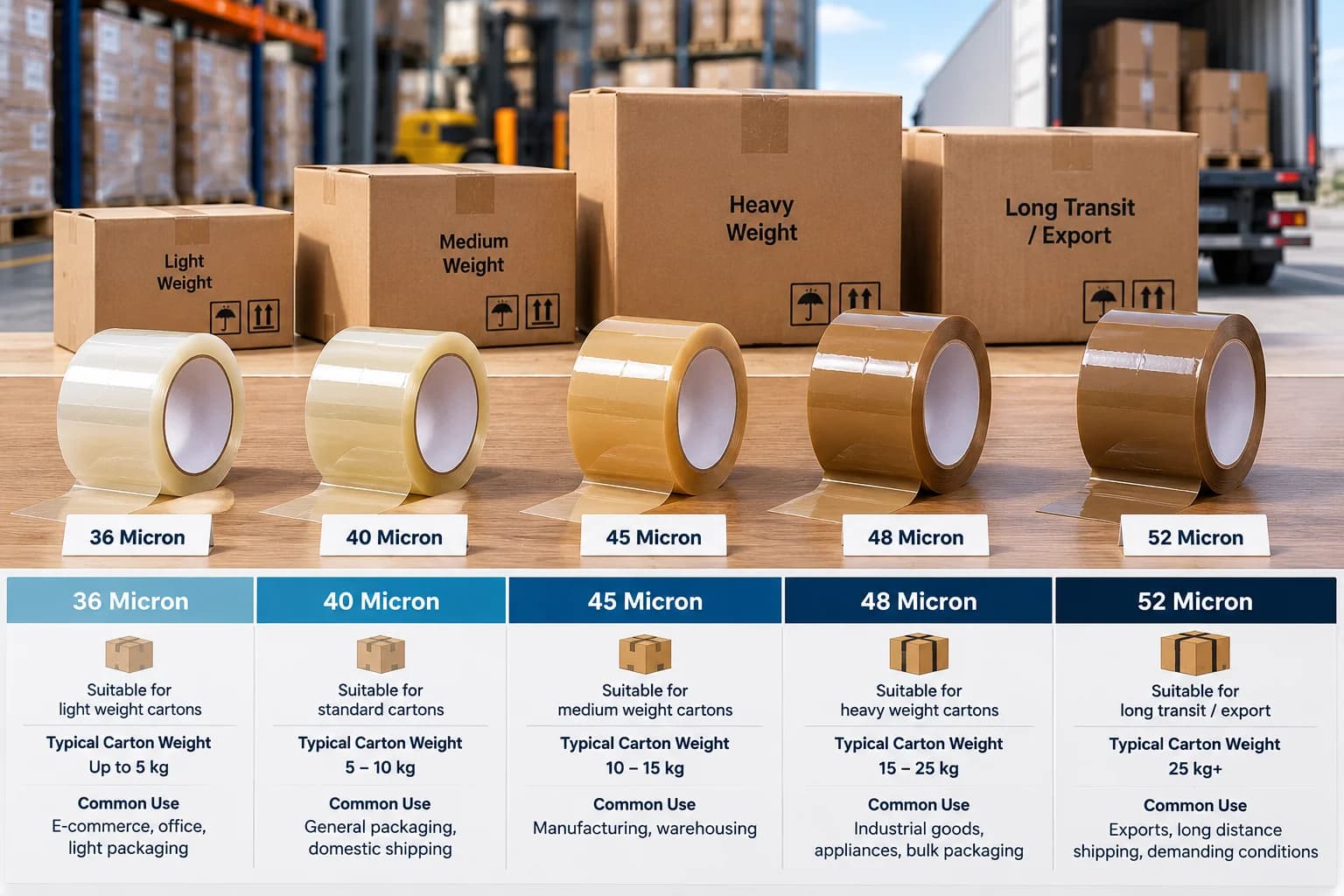
Most tape complaints we hear are not about adhesive quality. They are about the wrong micron being used for the job. A 35 micron tape on a 20 kg export carton will fail somewhere between the warehouse and the port. A 65 micron tape on a light 2 kg courier box is just money wasted on a carton that didn’t need it. Getting the gauge right is a simple decision once you break it into three factors: carton weight, transit distance, and storage time.
Why micron thickness matters more than people assume
Micron thickness refers to the BOPP film layer under the adhesive, not the adhesive coating itself. Thicker film resists puncture, holds its seal under flexing, and survives repeated handling without the edges lifting. Thinner film is cheaper per roll and fine for light, short-haul cartons, but it has less reserve strength when a box gets dropped, restacked, or left in a hot truck for two days.
Buying tape without checking the micron rating is like buying rope without checking its load rating. It might hold for a while. It won’t hold reliably.
35 to 40 micron: light loads, short transit
This range works for cartons under roughly 5 kg that move locally or regionally, with a transit time of a day or two. Think small FMCG cartons, stationery, light garments, or intra-city courier shipments. The carton gets sealed, loaded, delivered, and opened within a short window. There’s no need to pay for extra film thickness the box will never use.
- Typical use: local distribution, light retail cartons, short-haul courier
- Weight range: up to 5 kg
- Transit: same day to 2 days
- Storage before use: minimal, moved out quickly
45 micron: the standard for e-commerce and FMCG
This is the most commonly ordered micron for a reason. It handles the typical e-commerce carton weight of 5 to 10 kg, survives a few days in transit through multiple hands, including sorting hubs and last-mile delivery, and tolerates a moderate amount of handling without the seal lifting. If you’re not sure what to order and your cartons are standard e-commerce or FMCG cargo, 45 micron is the safe default.
- Typical use: e-commerce fulfilment, FMCG distribution, general trading goods
- Weight range: 5 to 10 kg
- Transit: 2 to 5 days, multiple handling points
- Storage before use: a few days to a couple of weeks
50 to 60 micron: heavier cartons, longer transit
Once cartons cross 10 kg, or the transit involves interstate trucking, railway freight, or several days on the road, 50 to 60 micron gives you the margin for error. This range also suits footwear, furniture components, and cartons that get stacked and restacked in a warehouse before dispatch. The extra film thickness resists the edge-lifting that happens when boxes rub against each other during a long haul.
- Typical use: heavier FMCG cartons, footwear and apparel bulk packs, furniture components, interstate transit
- Weight range: 10 to 20 kg
- Transit: 3 to 7 days, interstate movement
- Storage before use: a few weeks, possibly in a non-climate-controlled warehouse
65 micron and above: export, repeated handling, long storage
Export cartons go through customs handling, container loading, sea freight, and sometimes sit in storage for weeks before they even reach a port. They get handled by more people, stacked higher, and exposed to more temperature swings than a domestic shipment. 65 micron and above is the right choice here, along with pharma and cold-chain cartons that need a seal that holds through refrigerated transit and repeated inspection.
- Typical use: export shipments, pharma and cold-chain cartons, long-term warehousing
- Weight range: 20 kg and above, or high-value/sensitive goods regardless of weight
- Transit: a week or more, often international
- Storage before use: weeks to months
A quick way to decide
Ask three questions before placing an order:
- How heavy is the sealed carton? Heavier cartons need thicker film to resist tearing under their own weight during handling.
- How far and how many hands does it pass through? More transit points means more flexing and more chances for a seal to lift.
- How long does it sit before it’s opened? Tape that looks fine on day one can loosen after weeks in a hot warehouse if the micron is too thin for the job.
If two of the three answers point to a heavier gauge, go with the heavier gauge. The cost difference between 45 and 50 micron on a roll is small compared to the cost of a carton splitting open in transit.
What we do at Sonison
We manufacture across the 35 to 65+ micron range at our Mundka facility, coating water-based acrylic adhesive and slitting to width in-house. If you’re unsure which micron fits your carton weight and transit profile, send us the carton weight, the distance it travels, and how long it typically sits in storage. We’ll tell you straight whether you’re over-ordering or under-protecting your shipment, no guesswork needed.
Your product, our package
Send us your requirement
Widths, colours, artwork, monthly volume: share what you need and we will come back with a price and a date.