
Packaging Guides
BOPP Tape vs PVC Tape: Which One Fits Your Packing Line
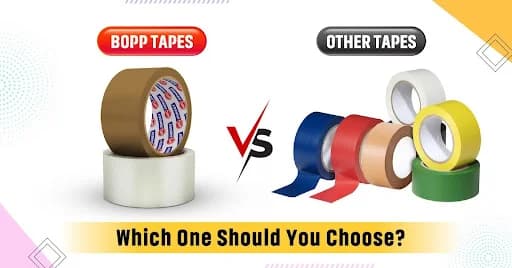
Buyers often ask us how BOPP tape stacks up against PVC tape. Both come as clear or brown rolls, both seal cartons, and at first glance they look interchangeable. They are not. The differences show up in how the tape ages on the shelf, how it looks on the box, how much noise it makes on a dispenser, and how fast it runs through a taping machine. Here is what actually separates the two, based on what we see on our own coating and slitting line.
Ageing and clarity
BOPP film is biaxially oriented polypropylene. It is dimensionally stable and does not yellow easily with age. A roll of BOPP tape stored in a normal warehouse for 12 to 18 months still unwinds and seals close to how it did on day one, as long as it was kept away from direct heat and sunlight. The clarity also holds up well over time, so printed barcodes and labels underneath stay readable.
PVC tape is made from plasticised polyvinyl chloride film. It tends to yellow faster, especially with heat exposure, because the plasticiser in the film breaks down over time. This is one reason PVC tape has largely gone out of favour for e-commerce and export cartons where boxes might sit in a warehouse for months before dispatch. For short shelf life and immediate use, the yellowing is not a practical issue. For anything with longer storage, BOPP holds its look better.
On raw clarity out of the roll, both films can be made optically clear. The difference is less about day-one clarity and more about how each one behaves after weeks in a hot godown or a container during transit.
Noise on the dispenser
This is the one buyers notice first on the floor. PVC tape is quieter when it unwinds, because the film itself is softer and the adhesive is usually a solvent-based rubber adhesive with a different tack profile. That is why PVC tape has traditionally been used in offices and retail counters where a loud dispenser is a genuine annoyance.
BOPP tape, particularly with a standard hand dispenser, makes more noise when pulled off the roll. This is simply the nature of the oriented polypropylene film. For a warehouse or dispatch floor running dozens of cartons an hour, this noise is not a real problem since machinery noise dominates anyway. For a quiet office packing counter, it can be noticeable. If noise is a genuine concern in a low-volume, quiet setting, that is one point in PVC’s favour. In a factory or fulfilment centre, it rarely matters.
Machine speed on the line
This is where BOPP has a clear practical edge for anyone running volume. BOPP tape is manufactured specifically for machine application, both semi-automatic and fully automatic case sealers. It has consistent tensile strength, predictable unwind tension, and an adhesive layer built to bond fast under pressure without needing extra dwell time. That means fewer jams, fewer roll changes mid-shift, and higher throughput on a case-sealing machine.
PVC tape was never really built for high-speed automatic sealing. It stretches more under tension, which can cause tracking issues on a machine head, and its adhesive does not always grab as fast under a sealer’s rollers. It works fine for manual taping with a hand dispenser at low to medium volume. Once a business moves to a machine-fed line doing hundreds or thousands of cartons a day, BOPP is almost always the better fit for keeping the line running without constant adjustment.
Where each one actually fits
- E-commerce fulfilment and FMCG dispatch: BOPP tape, usually 45 micron, handles the volume and the automatic sealers most fulfilment centres run.
- Export cartons with long transit and storage: BOPP tape at 50-65+ micron, because it needs to hold its seal and its look over weeks or months, sometimes through humidity and temperature swings in a container.
- Manual retail or office use, low volume: PVC tape still has a place here, especially where quiet dispensing and a soft feel matter more than machine compatibility.
- Furniture, footwear, and apparel packing lines: mostly BOPP, since these often run on semi-automatic sealers and need tape that holds against heavier or bulkier cartons.
- Pharma and cold-chain cartons: BOPP tape is preferred because it performs more predictably in cold storage handling and does not go brittle the way some PVC formulations can at low temperatures.
What we’d tell you if you asked
If your packing line is manual, low volume, and noise matters more than speed, PVC tape can still do the job. But for anything involving automatic case sealers, long storage, export shipping, or high daily carton counts, BOPP tape is the more practical choice. It runs faster on machines, ages better in storage, and keeps its clarity over time. That is also why most manufacturers, including us, have shifted almost entirely to BOPP production over the years. It is simply the tape that holds up under real warehouse and shipping conditions, not just on a countertop.
If you are still deciding between the two for a specific application, it helps to think about three questions: how the carton will be sealed, how long it will sit before it moves, and how many cartons you are sealing a day. The answers usually make the choice obvious.
Your product, our package
Send us your requirement
Widths, colours, artwork, monthly volume: share what you need and we will come back with a price and a date.