
Packaging Guides
BOPP Jumbo Rolls Explained: Mother Rolls and Who Buys Them
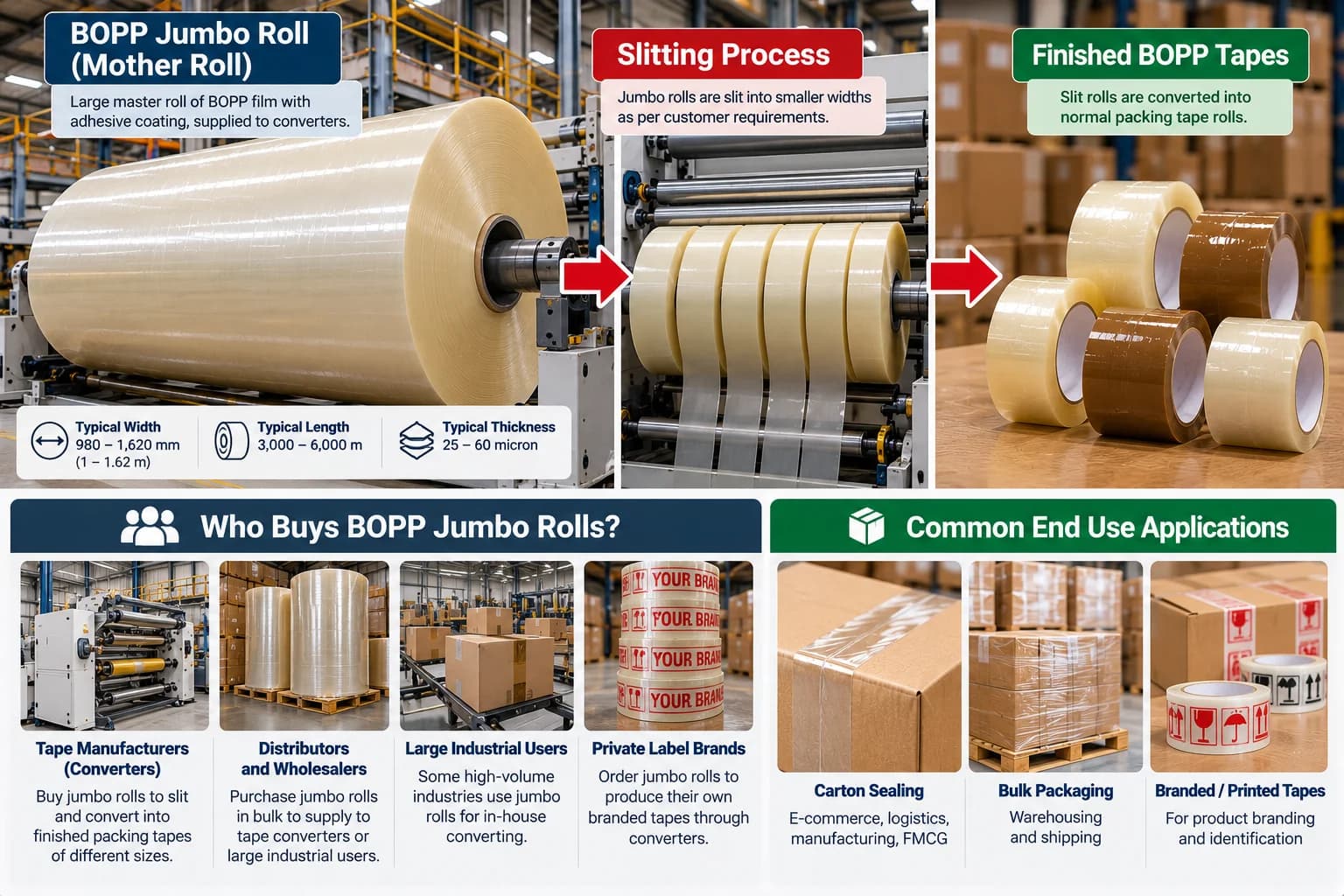
If you have only ever bought finished tape rolls, 48mm wide and 65 meters long, the idea of a jumbo roll might sound like just a bigger version of the same thing. It is not quite that simple. A jumbo roll is the raw, unslit output of a coating line, and understanding the difference matters if you are buying in bulk or thinking about converting tape yourself.
What a jumbo roll actually is
When we run our coating line, BOPP film passes through a water-based acrylic adhesive coater and then through rotogravure printing if the order calls for it. What comes out at the end is not a retail-ready tape roll. It is a wide roll, anywhere from 192mm to 1320mm in width, wound onto a heavy paper or plastic core, often several hundred meters long per wrap.
This wide roll is called a mother roll, or jumbo roll. It is not meant to be used as is on a carton sealing machine. It has to be slit down into the narrower widths that actually go on a tape dispenser, things like 24mm, 48mm, or 72mm. A jumbo roll is essentially a large stock of finished adhesive-coated film waiting to be cut to size.
Mother roll versus finished tape, the core difference
- Mother roll: wide format, 192mm to 1320mm, sold by weight or by the roll, used as raw material for converting.
- Finished tape roll: narrow format, typically 12mm to 96mm wide, cut to a specific length like 65m or 100m, ready for end use on a carton or package.
The adhesive, the film grade, and the micron thickness are decided at the jumbo roll stage. Slitting does not change any of that. It only changes the width and length of what the customer finally holds.
Who actually buys jumbo rolls
The main buyer of a jumbo roll is a slitting house. These are businesses that own slitting machines but not a coating line. They buy mother rolls in bulk, run them through their slitters, and sell the output as branded or unbranded finished tape to local distributors, retailers, or industrial buyers in their region. For a slitting house, the jumbo roll is their core raw material, the same way flour is to a bakery.
Beyond slitting houses, a few other buyer types show up regularly:
- Large packaging traders and distributors who want to control their own cutting specifications rather than depend on a supplier’s standard widths.
- Exporters and large FMCG operations that have their own in-house slitting or converting setup and prefer buying raw stock at a lower per-kg cost.
- Printers and converters who need printed jumbo rolls in bulk to slit into custom branded tape for their own client base.
A regular e-commerce warehouse or a small manufacturing unit almost never buys jumbo rolls directly. They do not have slitting equipment, and handling a 1-meter wide roll safely needs different machinery and floor space than handling finished tape cartons.
Typical widths and lengths you will see
Jumbo roll widths vary based on what the slitting house plans to produce. Common widths we supply run from 192mm up to 1320mm. A slitting house ordering a 960mm jumbo roll, for example, might be planning to cut it into twenty 48mm rolls, accounting for trim loss at the edges.
Length is usually expressed in meters per roll or in total weight, since winding length depends on the film thickness. A 35 micron film will yield more meters per kg than a 60 micron film on the same size core, simply because it is thinner. Buyers who deal in jumbo rolls regularly tend to order by weight and work out length themselves, since their slitting output planning depends on exact meterage per finished roll.
Why micron range still matters at the jumbo roll stage
Even though the final width is decided later, the micron thickness is fixed when the film is coated, so a slitting house still has to order the right micron for their end customers. Our micron range covers:
- 35 to 40 micron for light duty, short transit cartons
- 45 micron, the standard choice for e-commerce and FMCG
- 50 to 60 micron for heavier cartons and longer transit routes
- 65 micron and above for export cargo with repeated handling and long storage
A slitting house serving mostly e-commerce clients will mostly order 45 micron jumbo rolls. One supplying exporters will want 60 or 65 micron stock on hand. Getting this wrong at the jumbo roll stage means the problem shows up at every single finished roll cut from it, so it pays to be specific with your supplier about end use before placing a bulk order.
Plain versus printed jumbo rolls
Jumbo rolls can be supplied plain, in brown or natural colour, or pre-printed using rotogravure printing in up to three colours. A printed jumbo roll is useful for a converter who wants to slit directly into finished branded tape without running a separate printing step themselves. This saves them a machine pass, though it does mean committing to a print design before slitting, so print jumbo roll orders are usually larger volume runs.
What to check before placing a jumbo roll order
If you are a slitting house or converter sourcing jumbo rolls, a few things are worth confirming upfront with your supplier: exact width and core size compatible with your slitting machine, micron thickness matched to your end customer base, and whether the adhesive is water-based acrylic, since this affects slitting behaviour and edge adhesion once cut down. Since we manufacture jumbo rolls, mini jumbo rolls, and finished tape under one roof in our Mundka facility, we can supply either format depending on whether you are converting yourself or need ready-to-use tape.
Your product, our package
Send us your requirement
Widths, colours, artwork, monthly volume: share what you need and we will come back with a price and a date.