
Packaging Guides
Acrylic, Hot-Melt or Solvent Adhesive: Which Tape Holds Your Carton
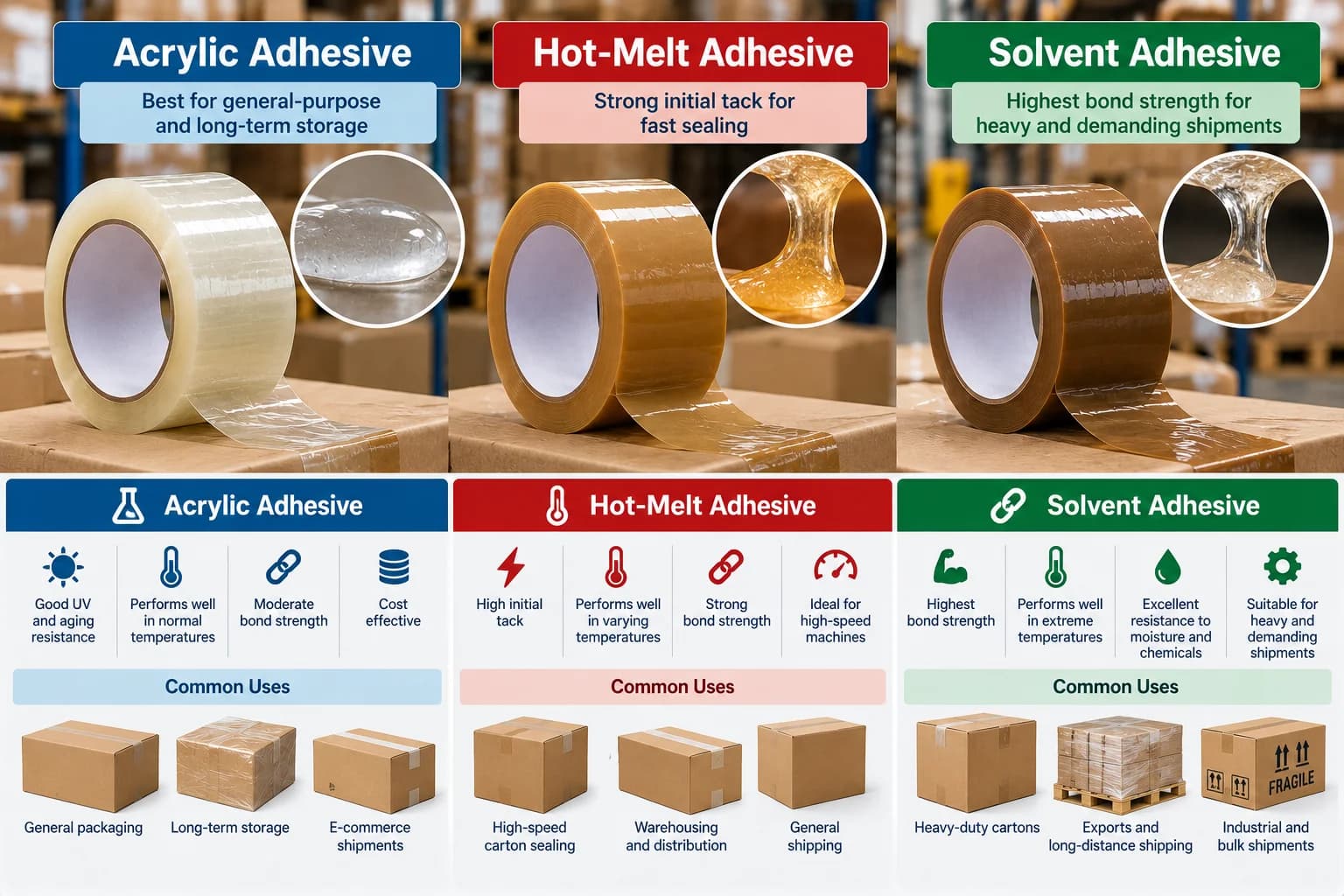
Most buyers compare tape on thickness and width. Fewer ask what the adhesive is actually made of. That is a mistake, because the adhesive layer, not the BOPP film, decides whether a carton stays shut through a 1,500 km truck journey or pops open on a warehouse shelf in June. This article is about the three adhesive families used on packaging tape and which cartons each one is built for.
Peel strength vs shear strength: the two numbers that matter
Tape adhesion is usually discussed as one vague idea, “stickiness.” In practice there are two separate properties and they pull in different directions.
- Peel strength is how hard it is to lift the tape off the surface at an angle. This is what you feel when you try to open a sealed carton by hand. High peel strength means tamper resistance and clean sealing on first contact.
- Shear strength is how well the tape resists sliding under constant load over time, without being pulled off directly. This is what keeps a carton flap from creeping open after it has sat stacked in a hot container for three weeks.
A tape can be strong on one and weak on the other. Hot-melt adhesives, for example, often give excellent instant peel but lose shear strength as temperature rises. Acrylic adhesives behave the opposite way. Knowing which property your shipment actually needs is the first decision, before you even look at micron.
Water-based acrylic adhesive
This is what we coat at our Mundka facility, and it is the adhesive most BOPP tape in India is made with. Acrylic is a polymer dispersed in water, applied to the film and dried in-line. Its behaviour:
- Stable adhesion from roughly 0°C to 60°C, so it does not go soft and oozy in a parked truck or a tin-roofed warehouse at noon.
- Good UV and ageing resistance, the bond does not degrade much if a carton sits in storage for months.
- Lower initial tack than hot-melt, meaning it needs a firm hand pass or machine pressure to bond well on first contact, especially on recycled or slightly dusty cartons.
- No solvent residue, no odour, which matters for pharma and food-adjacent packing where smell transfer is a concern.
Acrylic is the right default for e-commerce, FMCG, and most general carton sealing where the box goes through normal transit and storage conditions, not extreme heat or cold.
Hot-melt adhesive
Hot-melt is a rubber-resin compound applied molten and cooled instantly. It is common on tape used in colder climates or in some export markets.
- Very high instant tack, grabs the carton surface immediately, even on slightly dirty or recycled board.
- Works better in cold storage and winter conditions than acrylic, since it does not stiffen as much at low temperatures.
- Shear strength drops noticeably above 40°C, the bond can slide or the tape can “ooze” at the edges in a hot container, which is a real problem for Indian summers and for cartons stacked in non-air-conditioned trucks.
- Tends to yellow and harden with age faster than acrylic, so long-storage shipments are not its strong point.
Hot-melt suits short-transit, cold-chain adjacent, or quick-turnaround sealing where the carton is packed and shipped within days, not cartons that will sit in a hot warehouse for weeks before moving.
Solvent-based adhesive
Solvent adhesive is dissolved in an organic solvent, coated, then the solvent is evaporated off during drying. It is the oldest of the three technologies and less common now, mostly for cost and environmental reasons.
- Very strong, aggressive bond on difficult surfaces, including some poly-coated or waxed cartons that acrylic struggles with.
- Good temperature range, often wider than acrylic, which is why it still shows up in some export and industrial tape.
- Residual solvent smell can linger, which rules it out for pharma, food packaging, and anything sensitive to odour transfer.
- Manufacturing involves solvent handling and extraction, which adds cost and environmental compliance overhead compared to water-based coating.
Solvent tape still has a place on difficult or treated carton surfaces, but for standard kraft cartons it is usually not worth the trade-off against acrylic.
Matching adhesive to carton type
- Standard e-commerce and FMCG cartons, normal transit: water-based acrylic, 45 micron. Reliable across temperature swings during road transport.
- Export cartons, sea freight, long storage before opening: acrylic in 50-60 micron, sometimes 65+. Shear strength matters more here than instant tack since the box is handled once at each end, not repeatedly.
- Recycled or dusty carton board, quick dispatch: hot-melt or a higher-tack acrylic formulation, since first-contact grab matters more than long-term shear.
- Cold-chain and pharma cartons moving through controlled temperature: acrylic, for the no-odour and stable bond in refrigerated conditions. Hot-melt can stiffen and lose grip at low temperatures depending on the formulation.
- Furniture and heavier cartons under constant stacking load: acrylic with good shear strength, since the bond has to resist creep over days of warehouse stacking, not just an initial pull test.
What to ask your supplier
If a supplier cannot tell you whether their tape is acrylic or hot-melt, that is worth noting. Ask directly, and ask what micron and adhesive combination they recommend for your specific carton weight and transit length. A tape that performs well on a 5 kg carton over a 200 km road trip is a different product from one needed for a 20 kg export carton sitting in a container for six weeks. We coat acrylic adhesive in-house across the 35 to 65+ micron range at our Mundka facility, and the recommendation usually comes down to this match between adhesive behaviour, carton weight, and how long the box has to hold before anyone opens it again.
Your product, our package
Send us your requirement
Widths, colours, artwork, monthly volume: share what you need and we will come back with a price and a date.